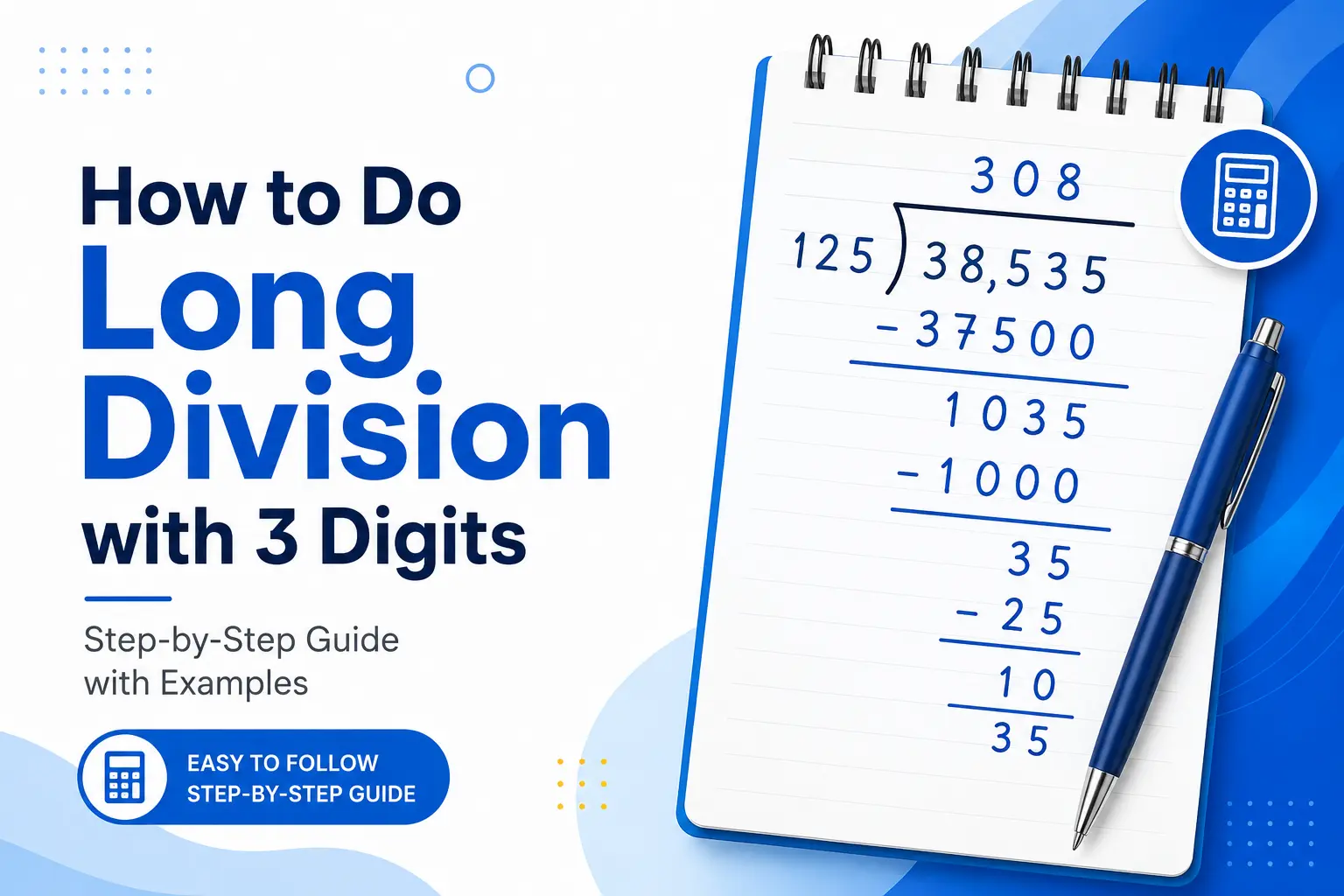
How to Do Long Division with 3 Digits(Step-by-Step Guide with Examples)
Table of Contents
Introduction
Long division may seem difficult at first, especially when the divisor has three digits. However, once you understand the process, dividing large numbers becomes much easier. In this guide, you’ll learn exactly how to divide by 3-digit numbers, follow worked examples, avoid common mistakes, and practice on your own our Long Division Calculator.
What Is Long Division?
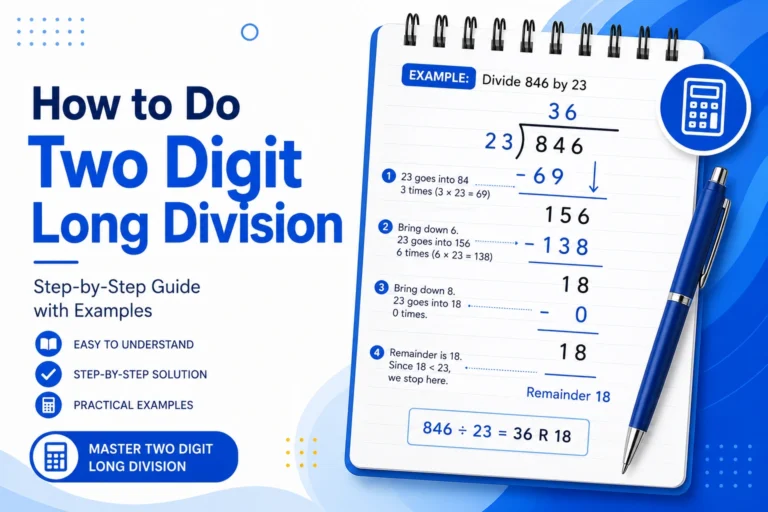
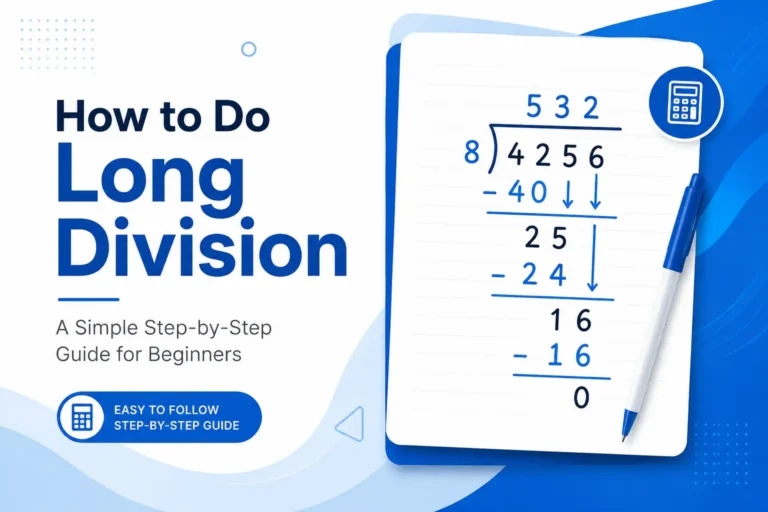
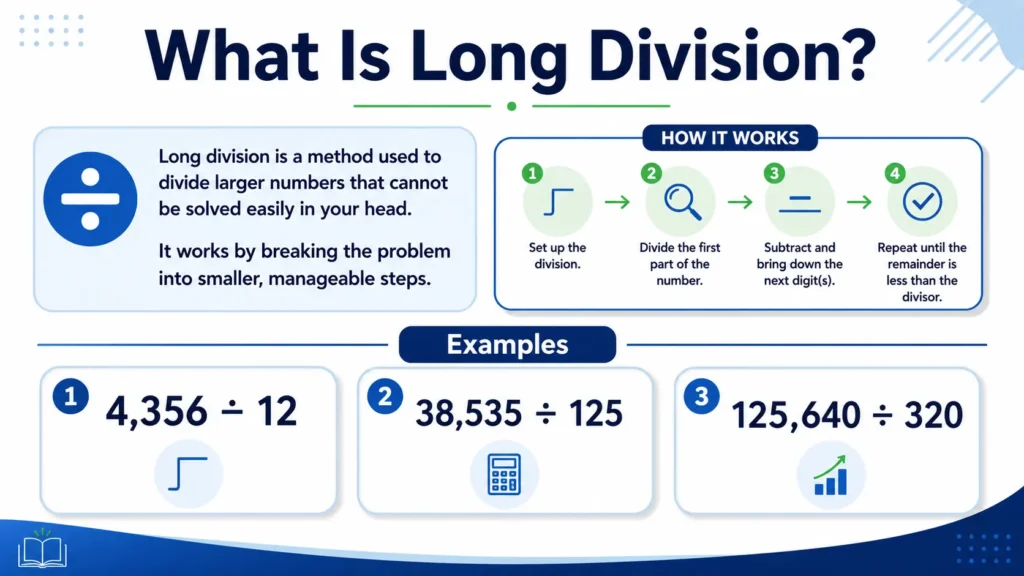
Long division is a method used to divide larger numbers that cannot be solved easily in your head. It works by breaking the problem into smaller, manageable steps. For beginners, our complete long division guide explains the basic process step by step.
For example:
125,640 ÷ 320
4,356 ÷ 12
38,535 ÷ 125
Parts of a Division Problem
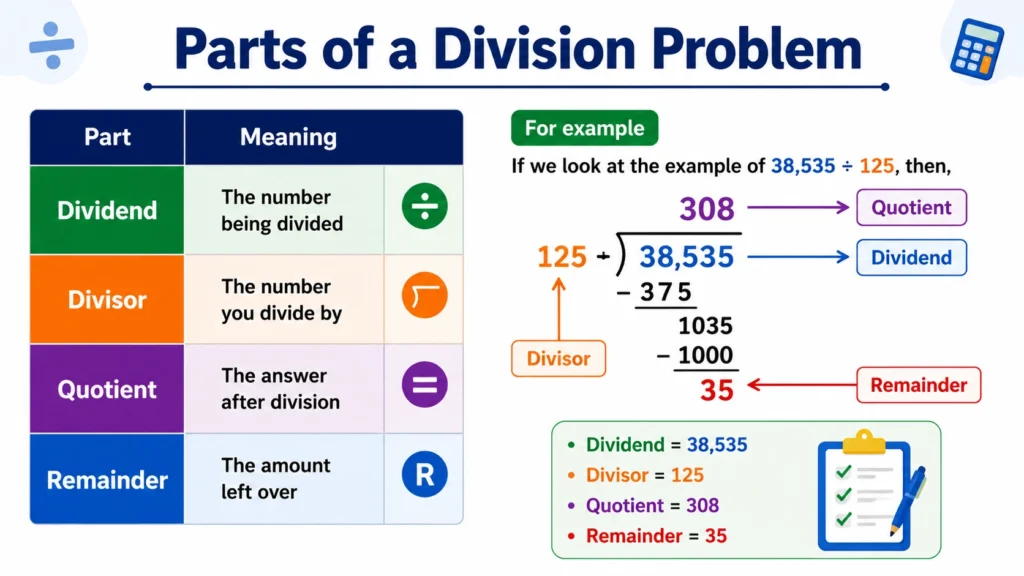
| Part | Meaning |
|---|---|
| Dividend | The number being divided |
| Divisor | The number you divide by |
| Quotient | The answer after division |
| Remainder | The amount left over |
For example
If we look at the example of 38535 ÷ 125, then,
- Dividend = 38,535
- Divisor = 125
- Quotient = 308
- Remainder = 35
Rules Before Dividing by a 3-Digit Number
Before solving any long division problem with a 3-digit divisor, it’s important to understand a few basic rules. These rules help you decide where to begin dividing, how to estimate the correct quotient, and how to avoid common mistakes. Before starting, you can practice these concepts and check your division answers using our calculator.
Taking a moment to review these guidelines will make the division process easier, more accurate, and less confusing, especially when working with large numbers. If you are new to division, start by understanding the basic long division method before solving problems with three-digit divisors.
Count the Digits in the Divisor
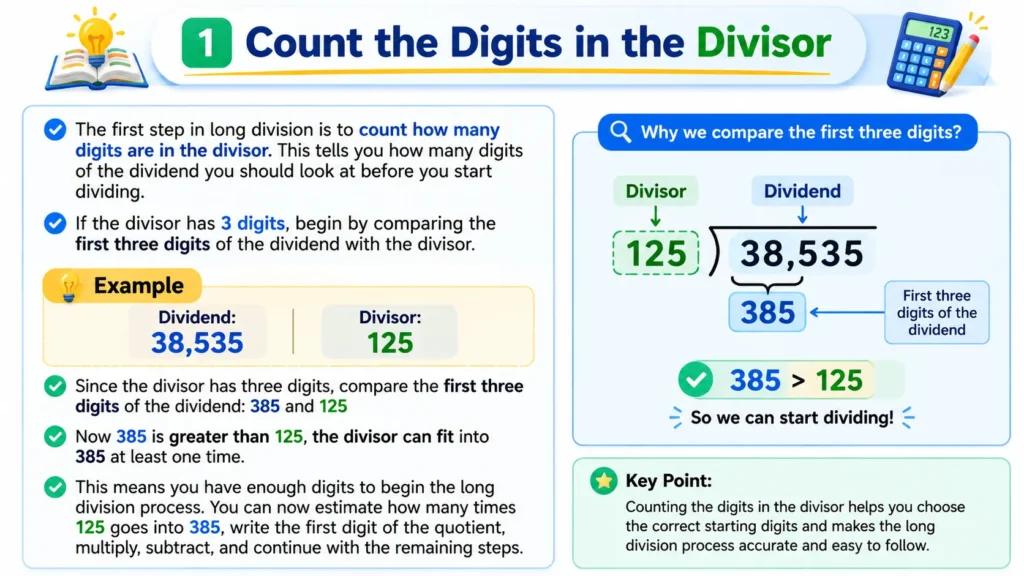
The first step in long division is to count how many digits are in the divisor. This tells you how many digits of the dividend you should look at before you start dividing. If the divisor has 3 digits, begin by comparing the first three digits of the dividend with the divisor.
Example
Dividend: 38,535
Divisor: 125
Since the divisor has three digits, compare the first three digits of the dividend: 385 and 125
Now 385 is greater than 125, the divisor can fit into 385 at least one time. This means you have enough digits to begin the long division process. You can now estimate how many times 125 goes into 385, write the first digit of the quotient, multiply, subtract, and continue with the remaining steps of long division.
2. If the First Three Digits Are Smaller
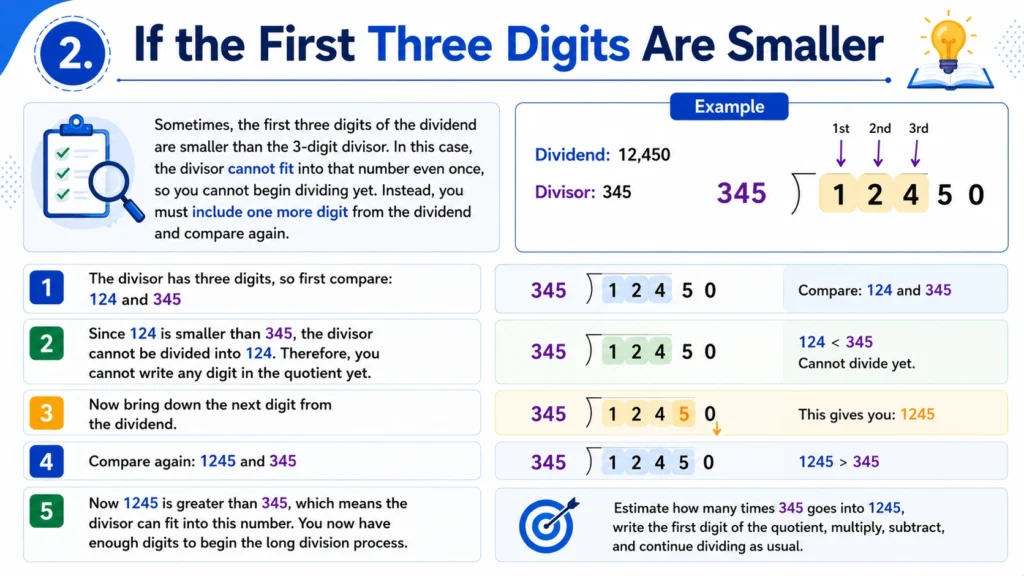
Sometimes, the first three digits of the dividend are smaller than the 3-digit divisor. In this case, the divisor cannot fit into that number even once, so you cannot begin dividing yet. Instead, you must include one more digit from the dividend and compare again.
Example
Dividend: 12,450
Divisor: 345
The divisor has three digits, so first compare: 124 and 345
Since 124 is smaller than 345, the divisor cannot be divided into 124. Therefore, you cannot write any digit in the quotient yet. Now bring down the next digit from the dividend.
This gives you: 1245
Compare again: 1245 and 345
Now 1245 is greater than 345, which means the divisor can fit into this number. You now have enough digits to begin the long division process. Estimate how many times 345 goes into 1245, write the first digit of the quotient, multiply, subtract, and continue dividing as usual.
Step-by-Step Method for Dividing by a 3-Digit Number
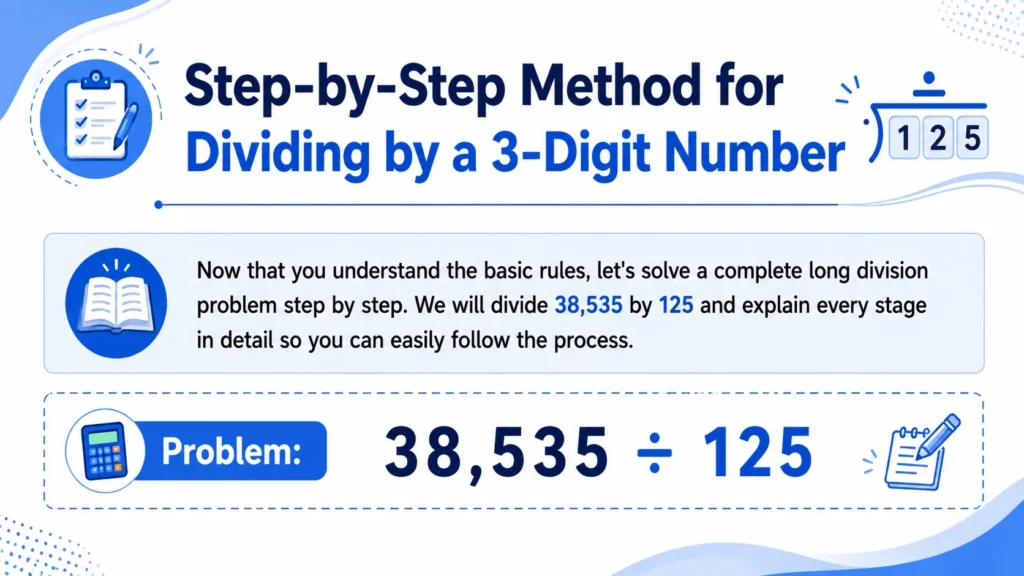
Now that you understand the basic rules, let’s solve a complete long division problem step by step. We will divide 38,535 by 125 and explain every stage in detail so you can easily follow the process.
Problem:
38,535 ÷ 125
Step 1: Set Up the Division
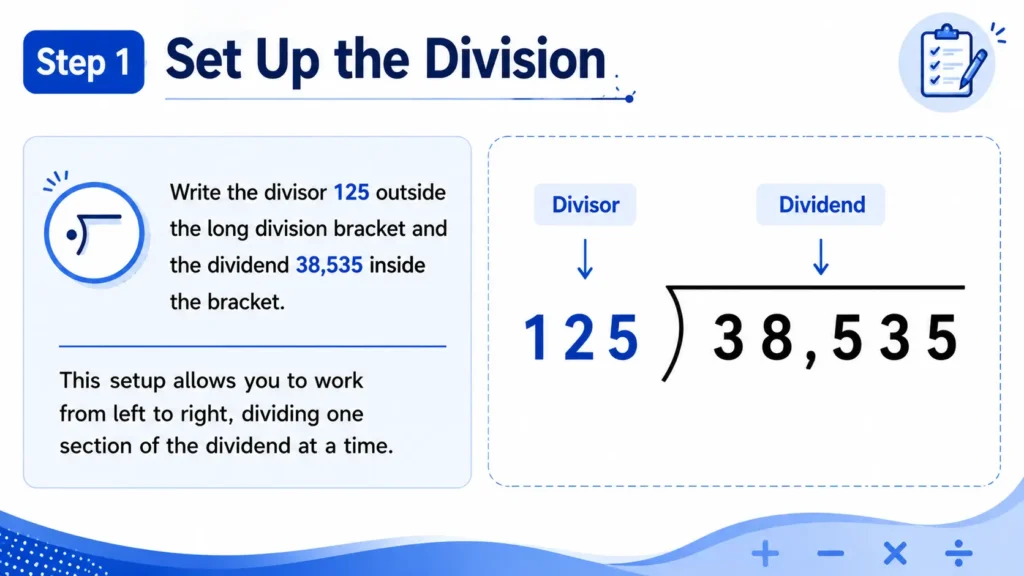
Write the divisor 125 outside the long division bracket and the dividend 38,535 inside the bracket. This setup allows you to work from left to right, dividing one section of the dividend at a time.
Step 2: Compare the First Three Digits
Since the divisor 125 has three digits, compare it with the first three digits of the dividend.
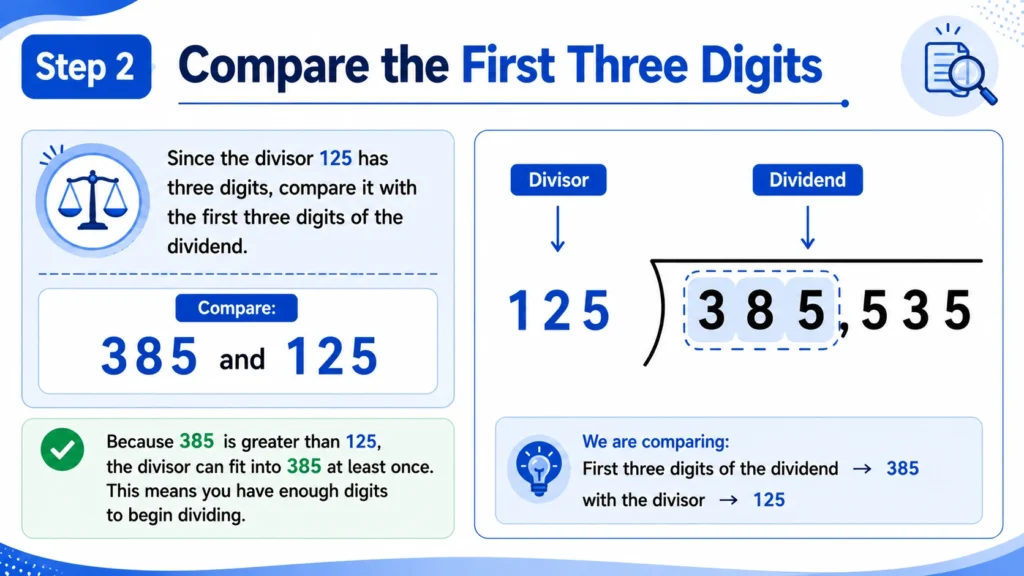
Compare:
385 and 125
Because 385 is greater than 125, the divisor can fit into 385 at least once. This means you have enough digits to begin dividing.
Step 3: Estimate the First Quotient Digit
Instead of calculating the exact answer immediately, estimate how many times 125 can fit into 385. A quick estimation is made by comparing the first digits.
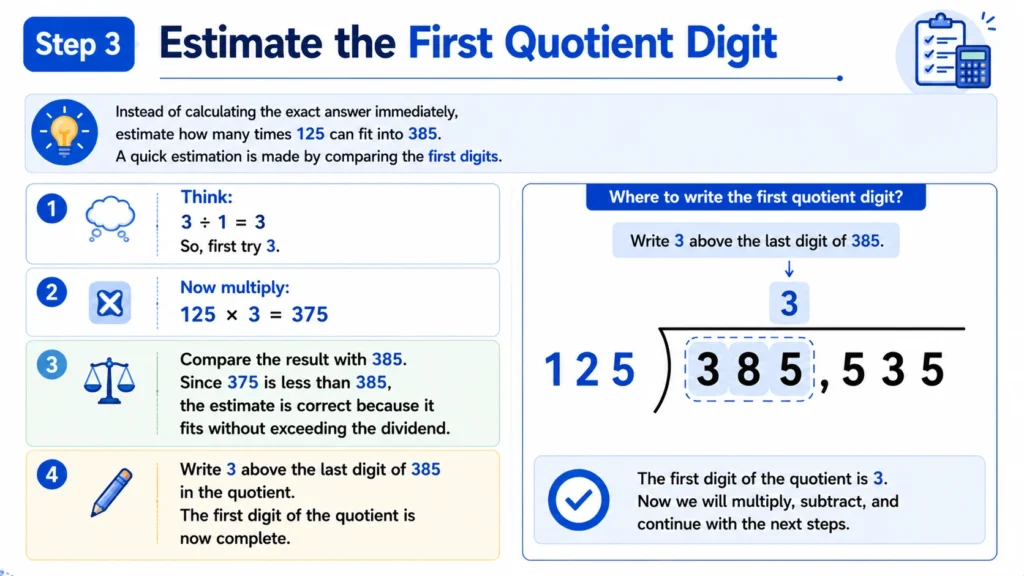
Think:
3 ÷ 1 = 3
So, first try 3.
Now multiply:
125 × 3 = 375
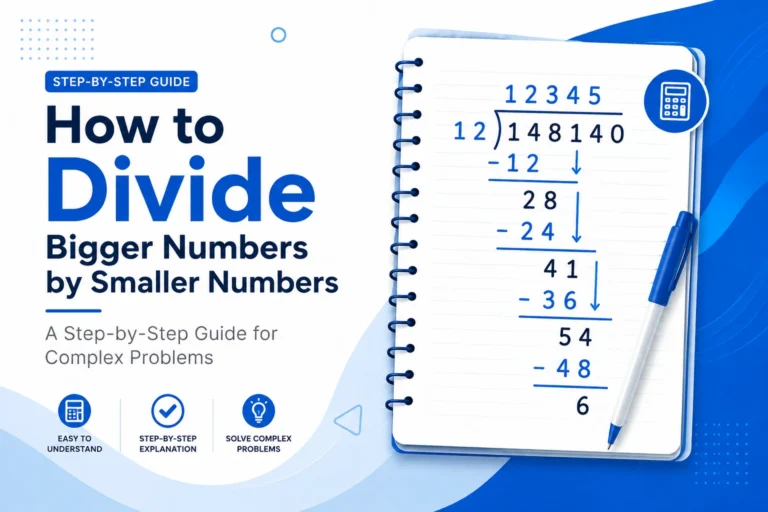
Compare the result with 385. Since 375 is less than 385, the estimate is correct because it fits without exceeding the dividend. Write 3 above the last digit of 385 in the quotient. The first digit of the quotient is now complete. If you want to learn more techniques for solving larger division problems, check our guide on how to divide bigger numbers by smaller numbers.
Step 4: Multiply and Subtract
Multiply the divisor by the quotient digit you just found: 125 × 3 = 375
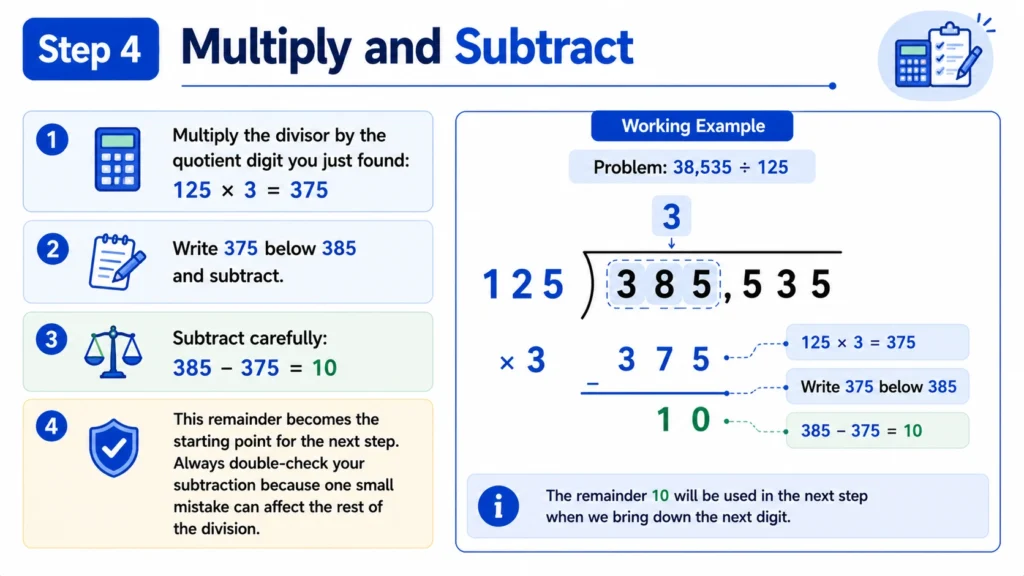
Write 375 below 385 and subtract. Subtract carefully:
385 − 375 = 10
This remainder becomes the starting point for the next step. Always double-check your subtraction because one small mistake can affect the rest of the division.
Step 5: Bring Down the Next Digit
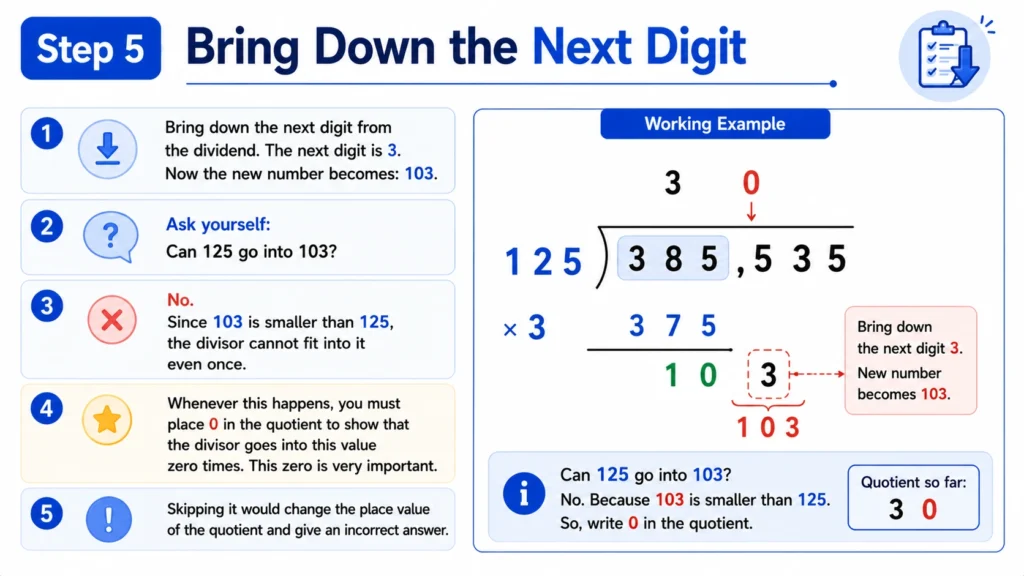
Bring down the next digit from the dividend. The next digit is 3. Now the new number becomes: 103. Ask yourself:
Can 125 go into 103?
No.
Since 103 is smaller than 125, the divisor cannot fit into it even once. Whenever this happens, you must place 0 in the quotient to show that the divisor goes into this value zero times. This zero is very important. Skipping it would change the place value of the quotient and give an incorrect answer.
Step 6: Bring Down Another Digit
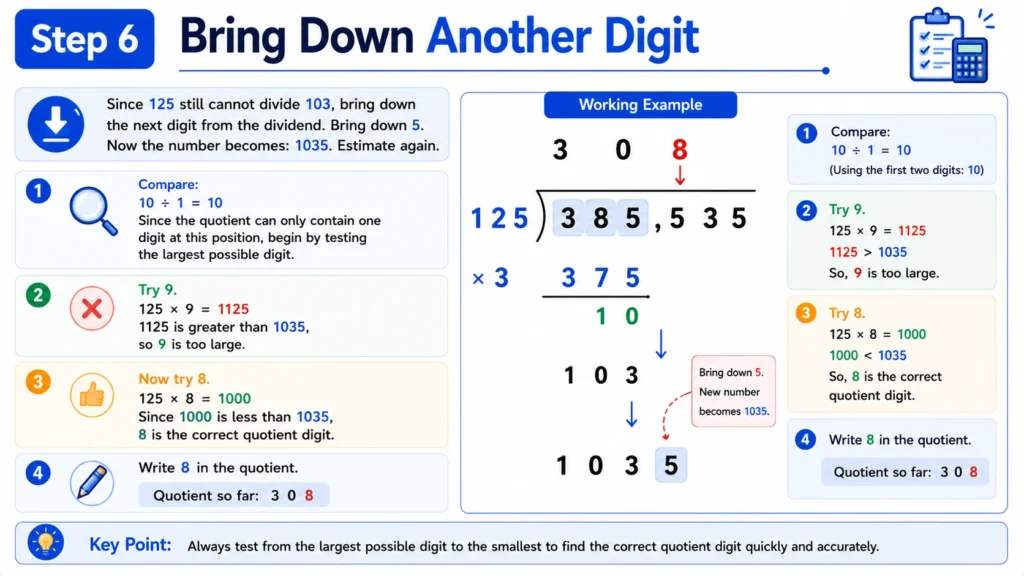
Since 125 still cannot divide 103, bring down the next digit from the dividend. Bring down 5. Now the number becomes: 1035. Estimate again.
Compare:
10 ÷ 1 = 10
Since the quotient can only contain one digit at this position, begin by testing the largest possible digit. Try 9.
125 × 9 = 1125
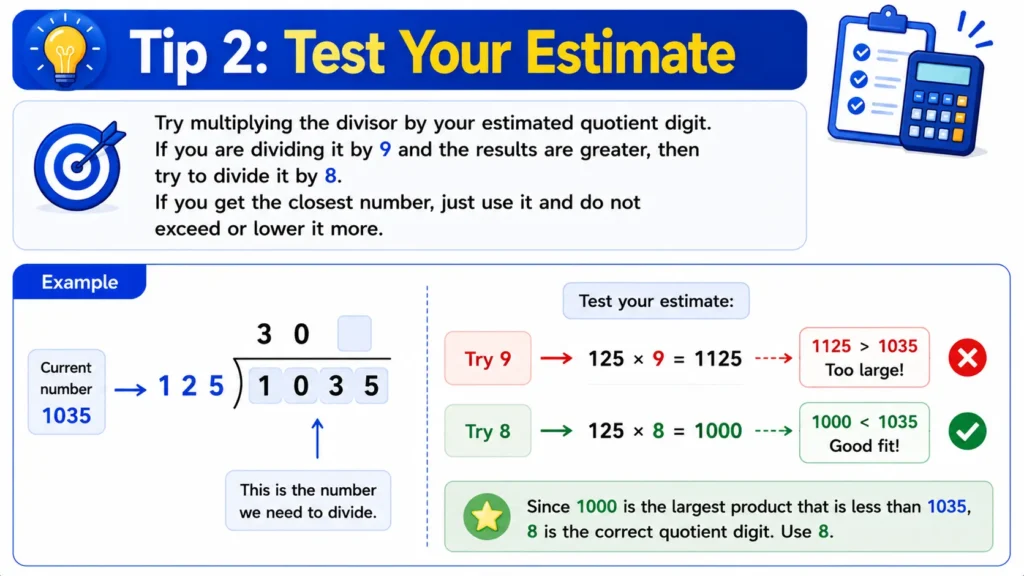
1125 is greater than 1035, so 9 is too large. Now try 8.
125 × 8 = 1000
Since 1000 is less than 1035, 8 is the correct quotient digit. Write 8 in the quotient.
Step 7: Multiply and Subtract Again
Multiply the divisor by 8. 125 × 8 = 1000. Write 1000 below 1035 and subtract. Subtract carefully:
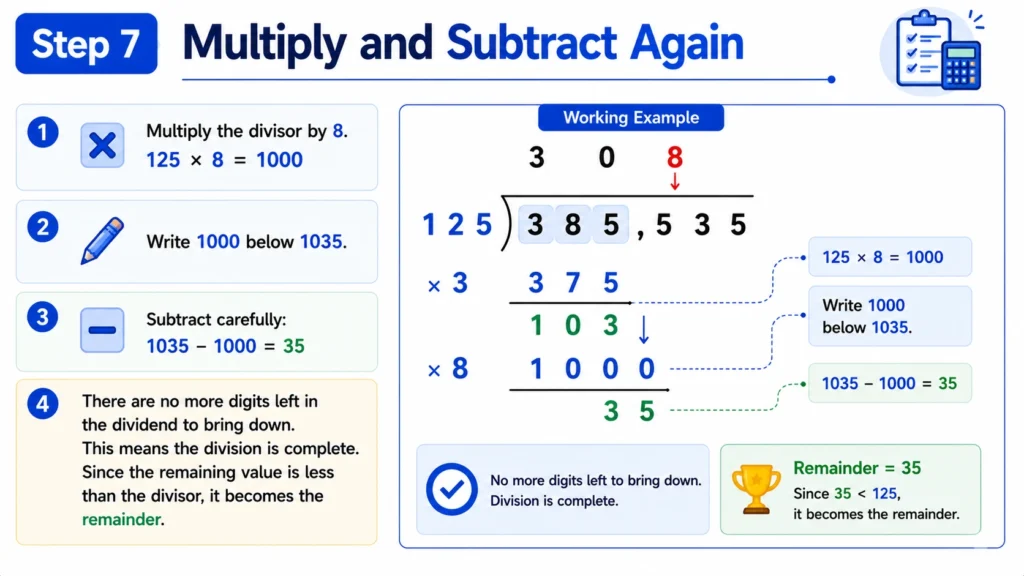
1035 − 1000 = 35
There are no more digits left in the dividend to bring down. This means the division is complete. Since the remaining value is less than the divisor, it becomes the remainder.
Final Answer
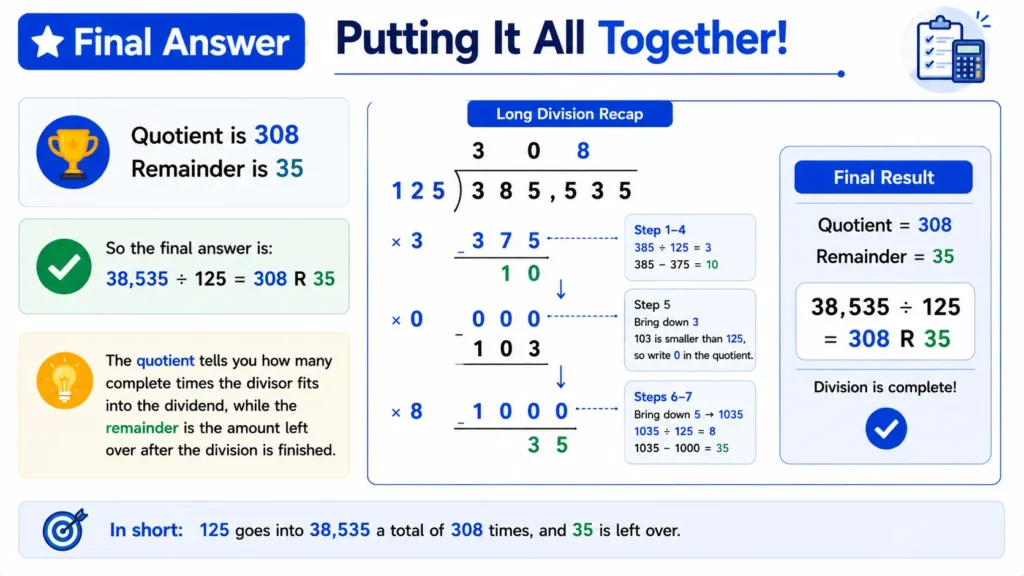
Quotient is 308 and Remainder is 35 so the final answer is 38,535 ÷ 125 = 308 R 35. The quotient tells you how many complete times the divisor fits into the dividend, while the remainder is the amount left over after the division is finished. You can practice repeating these steps using our calculator.
Tips for Estimating the Quotient
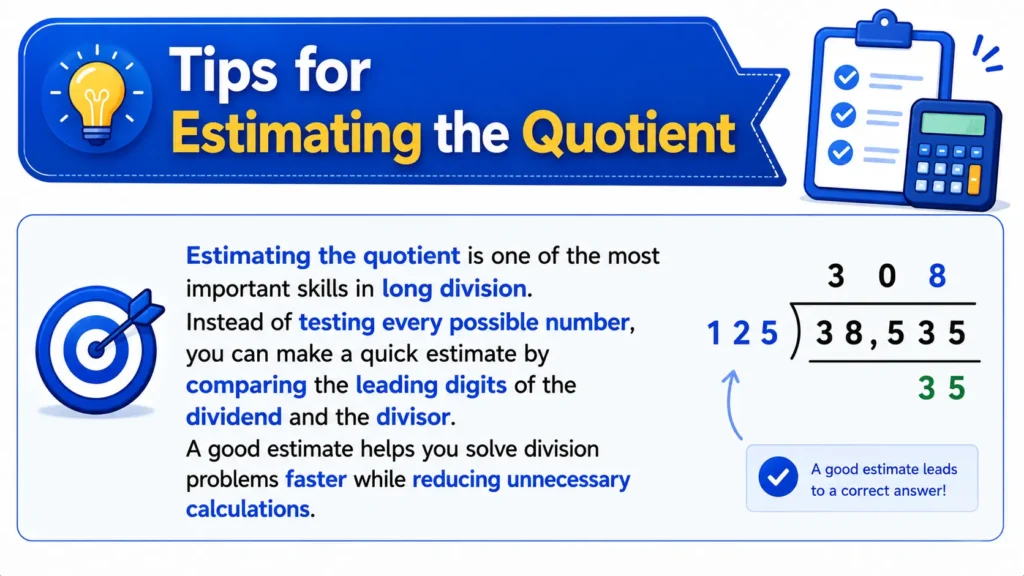
Estimating the quotient is one of the most important skills in long division. Instead of testing every possible number, you can make a quick estimate by comparing the leading digits of the dividend and the divisor. A good estimate helps you solve division problems faster while reducing unnecessary calculations.
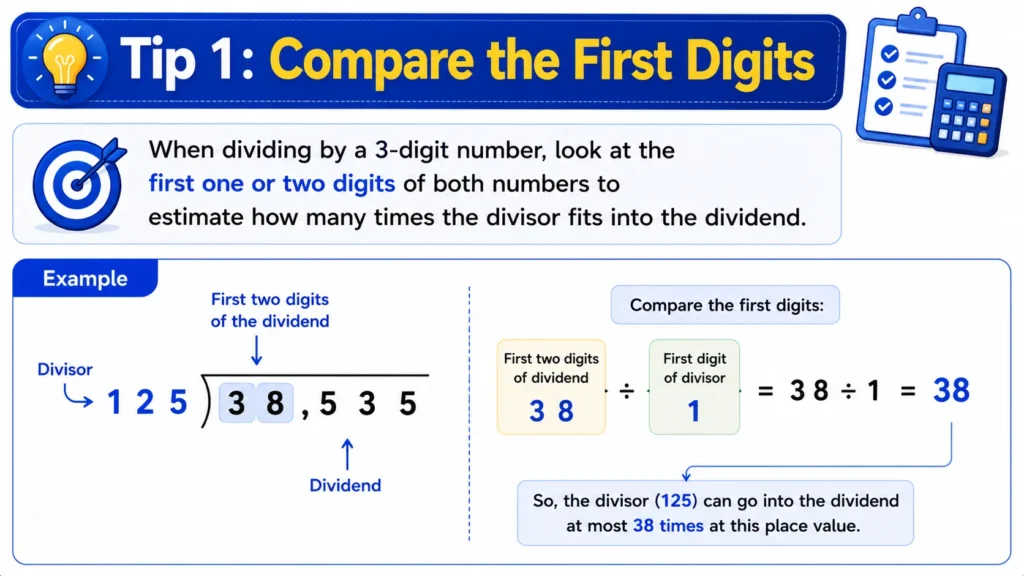
Tip 1: Compare the First Digits
When dividing by a 3-digit number, look at the first one or two digits of both numbers to estimate how many times the divisor fits into the dividend.
Tip 2: Test Your Estimate
Try multiplying the divisor by your estimated quotient digit. If you are dividing it by 9 and the results are greater, then try to divide it by 8. If you get the closest number, just use it and do not exceed or lower it more.
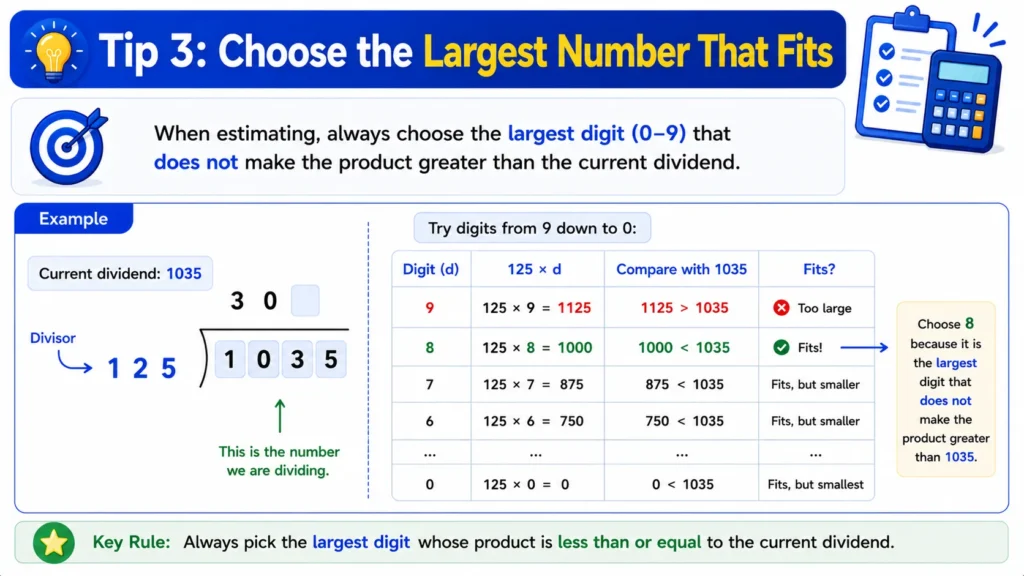
Tip 3: Choose the Largest Number That Fits
When estimating, always choose the largest digit (0–9) that does not make the product greater than the current dividend.
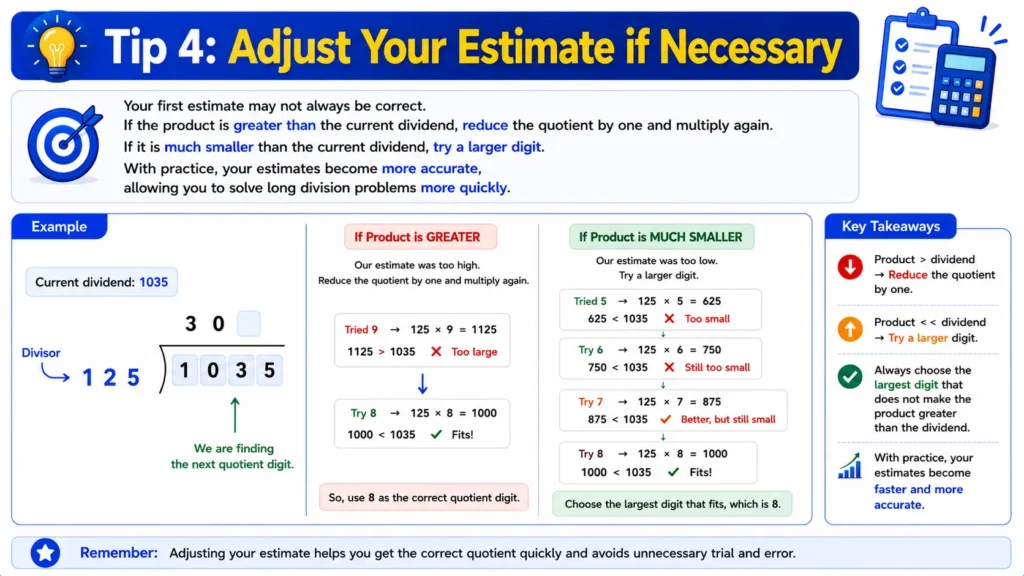
Tip 4: Adjust Your Estimate if Necessary
Your first estimate may not always be correct. If the product is greater than the current dividend, reduce the quotient by one and multiply again. If it is much smaller than the current dividend, try a larger digit. With practice, your estimates become more accurate, allowing you to solve long division problems more quickly.
Common Mistakes to Avoid
Even if you understand the steps of long division, small mistakes can lead to incorrect answers. Knowing these common errors will help you avoid them and improve your accuracy.

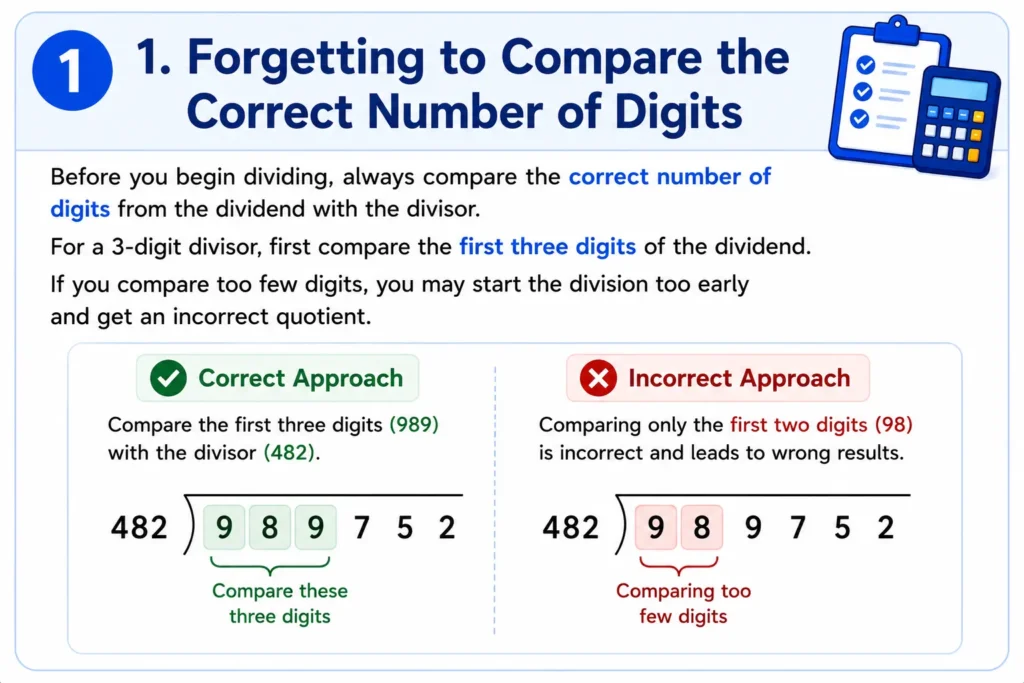
1. Forgetting to Compare the Correct Number of Digits
Before you begin dividing, always compare the correct number of digits from the dividend with the divisor. For a 3-digit divisor, first compare the first three digits of the dividend. If you compare too few digits, you may start the division too early and get an incorrect quotient.
2. Choosing a Quotient Digit That Is Too Large
A common mistake is selecting a quotient digit that makes the multiplication result larger than the current dividend. Suppose there is a current dividend 1035 and divisor is 125 and you choose 9, 125 × 9 = 1125, since 1125 is greater than 1035, 9 cannot be the correct quotient digit.
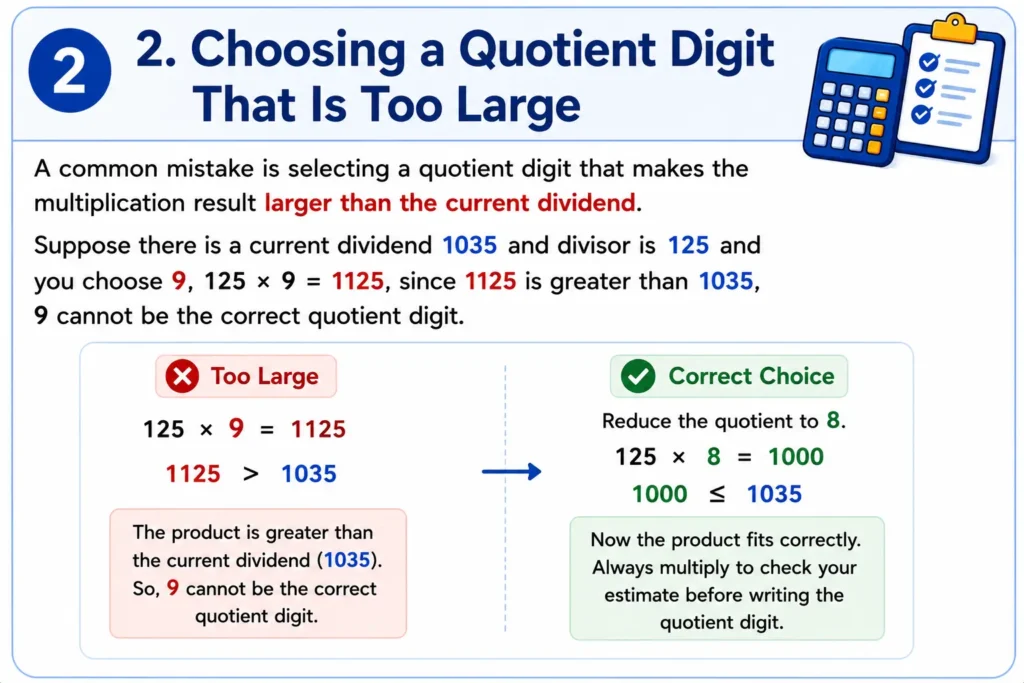
Reduce the quotient to 8. 125 × 8 = 1000 Now the product fits correctly. Always multiply to check your estimate before writing the quotient digit.
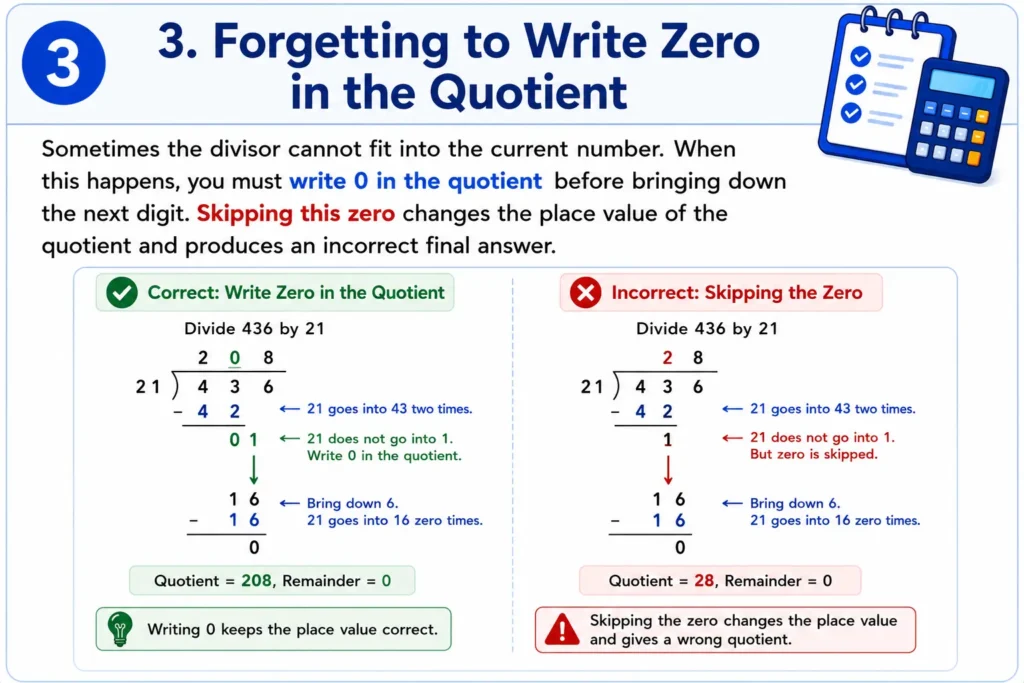
3. Forgetting to Write Zero in the Quotient
Sometimes the divisor cannot fit into the current number. When this happens, you must write 0 in the quotient before bringing down the next digit. Skipping this zero changes the place value of the quotient and produces an incorrect final answer.
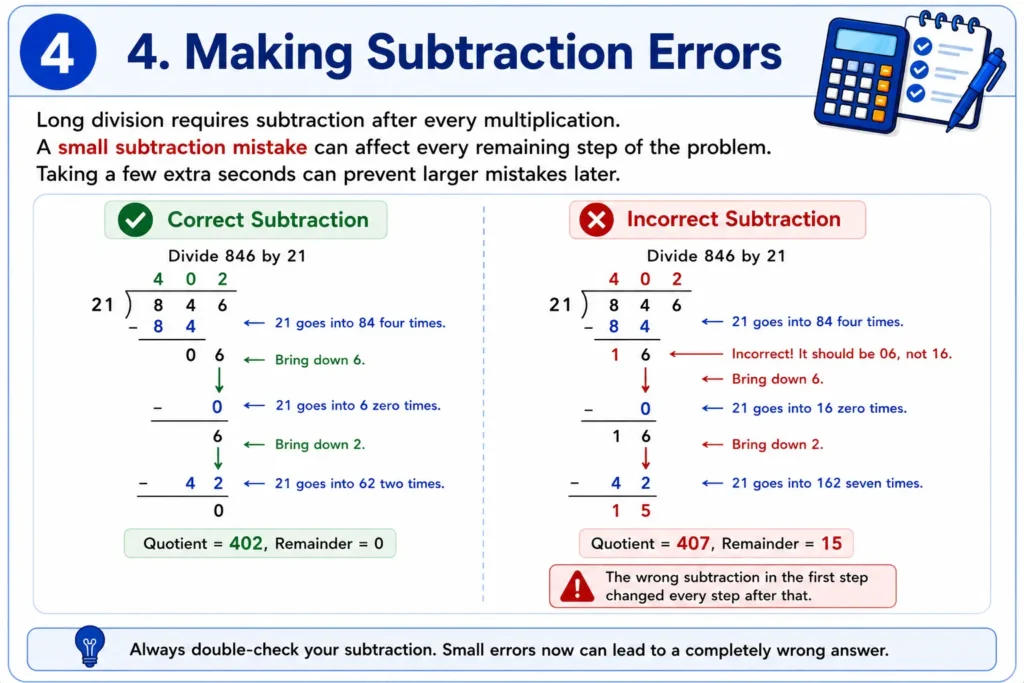
4. Making Subtraction Errors
Long division requires subtraction after every multiplication. A small subtraction mistake can affect every remaining step of the problem. Taking a few extra seconds can prevent larger mistakes later.
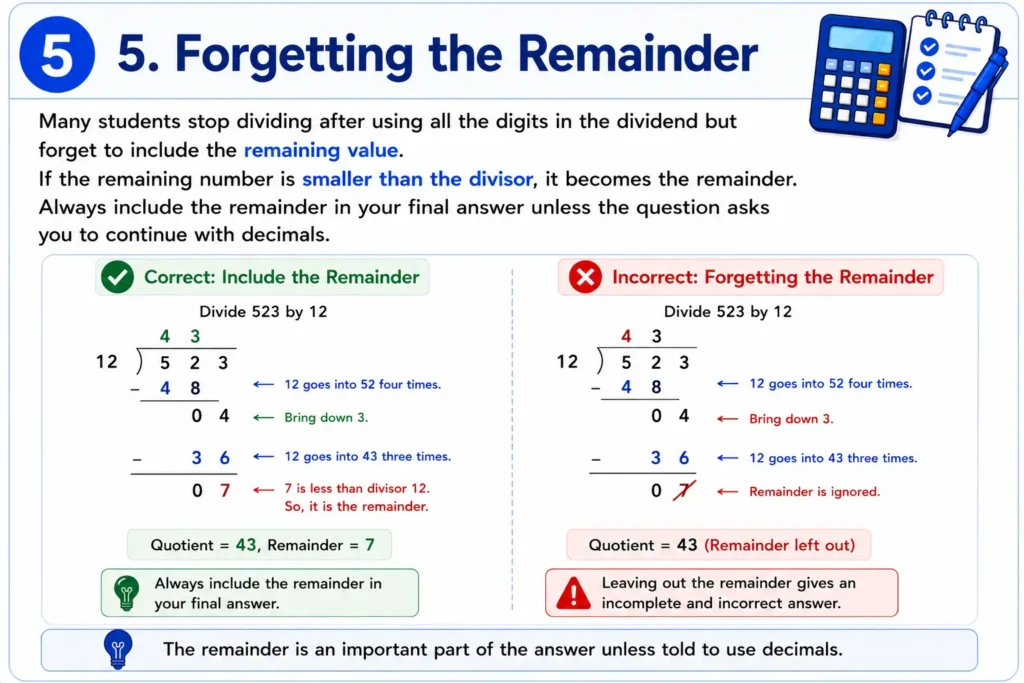
5. Forgetting the Remainder
Many students stop dividing after using all the digits in the dividend but forget to include the remaining value. If the remaining number is smaller than the divisor, it becomes the remainder. Always include the remainder in your final answer unless the question asks you to continue with decimals.
Conclusion
Dividing by a 3-digit number may look difficult in the beginning, but by following the correct steps, it becomes easy to solve. Always remember to compare the numbers, estimate the quotient, multiply, subtract, and bring down the next digit carefully. With regular practice and careful calculation, you can improve your division skills and solve large number problems with confidence. If you are still learning the basics, start with two digit long division first, where you can understand the same divide, multiply, subtract, and bring down method before moving to larger three-digit divisors.