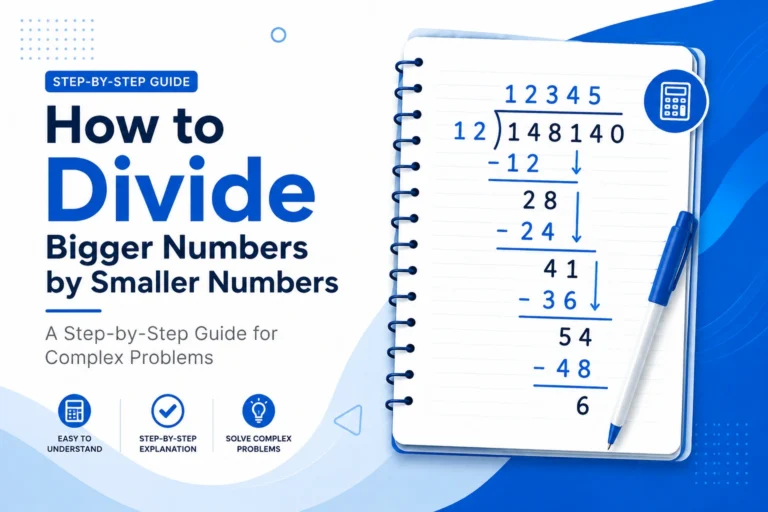
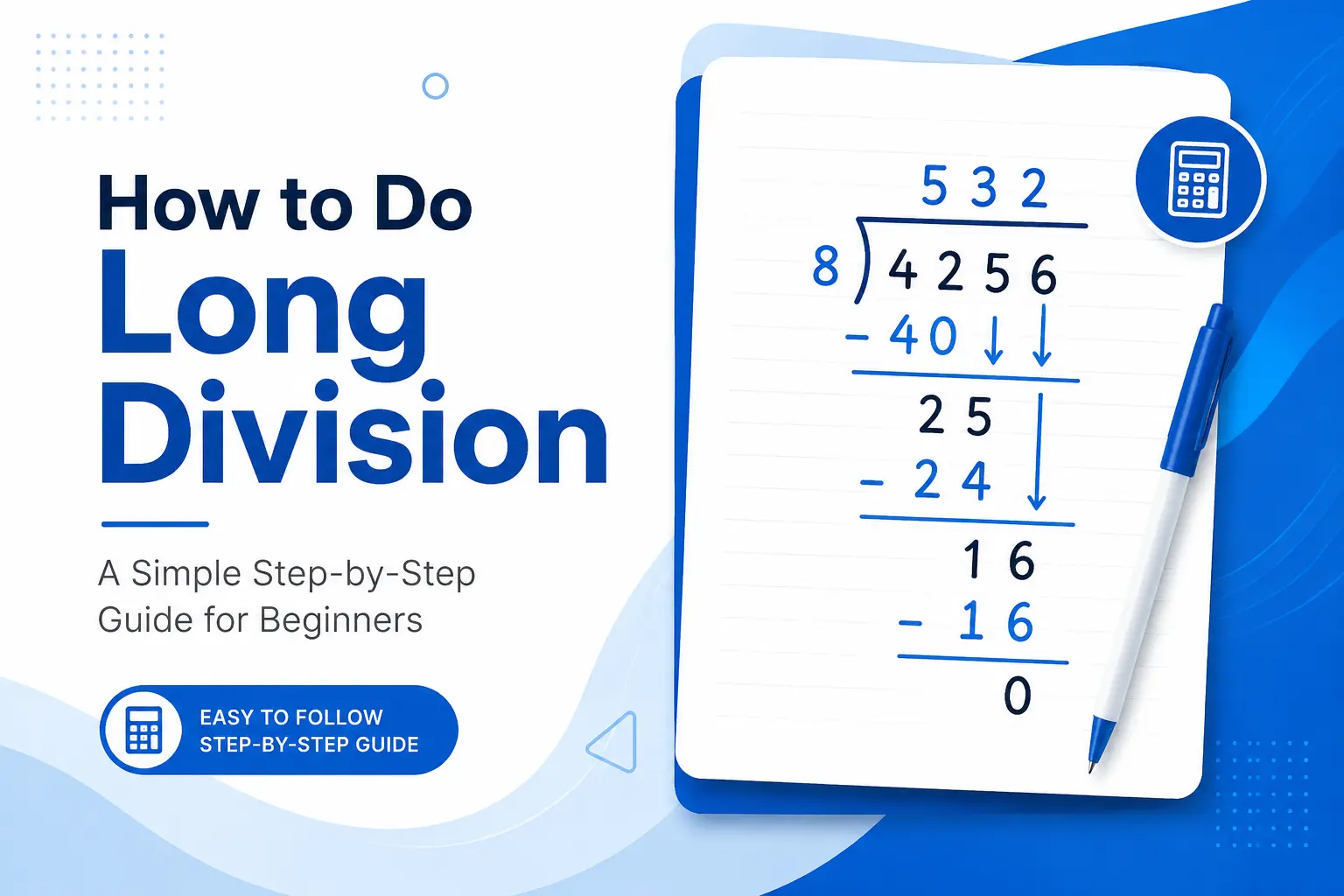
How to Do Long Division
Introduction
Long division seems a little complicated to people who are not aware of the complete steps. But everything seems easier when you divide it into small parts. In this page, you are going to explore what is long division and why each step is important in division. You can also practice each example using our Long Division Calculator.
What is the Long Division?
Long division is a process of breaking larger numbers into smaller parts. It is also the opposite of multiplication, as it is about combining the equal groups to find the total. While long division is figuring out what smaller numbers were multiplied together to make it.
Division helps you work with numbers more easily, and long division is especially useful when the numbers are very large. It lets you break down problems step by step, so the process feels less overwhelming.
How to do long division in easy steps
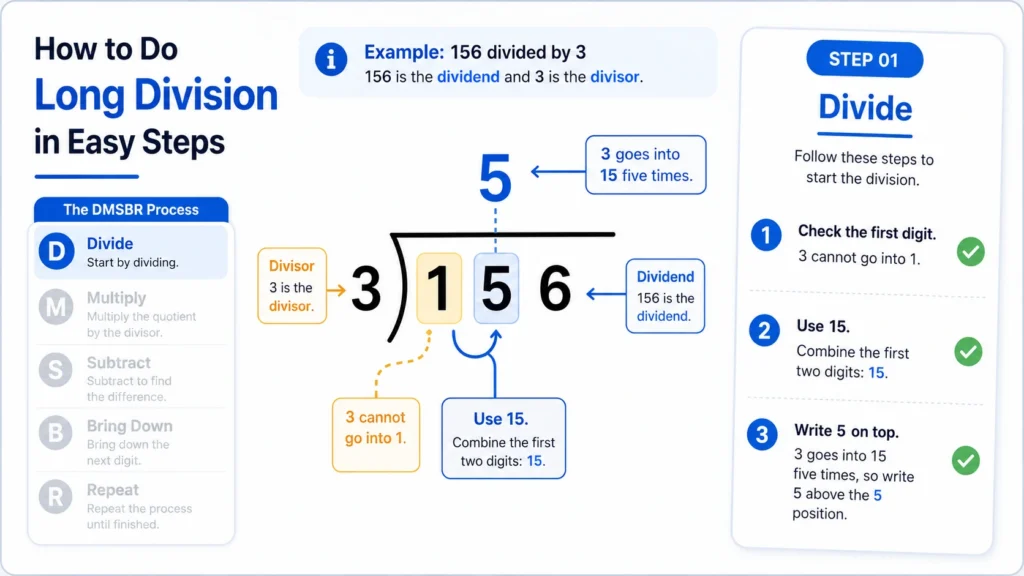
Long division is a step-by-step method for dividing a multi digital number using the DMSBR process; divide, multiply, subtract, bring it down and repeat. Lets break all process simply:
Step 01 Divide:
In the first step, you look at the first digit or first 2 digits of the dividend and see how many times the divisor can go into it. You write that number on top, the quotient. If the divisor is larger than the first digit, you take more digits from the dividend until it becomes divisible.
For Example:
Let’s take 156 ÷ 3 as an example. 156 is a dividend and 3 is divisor. Now 3 cannot go in 1 so we take two digits 15. Now 3 comes 5 times in 15 so we write 5 in quotient, at the top of under root.
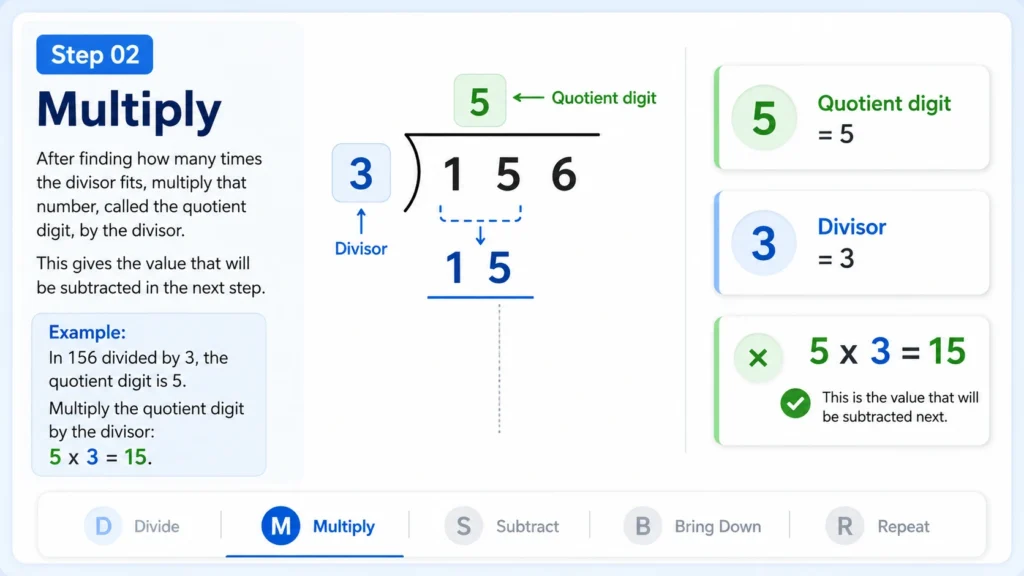
Step 02: Multiply:
After finding how many times the divisor fits, you multiply that number (quotient digit) by the divisor. This gives you a value that you will subtract in the next step.
For Example:
Now we will multiply the quotient digit by the divisor:
5 × 3 = 15
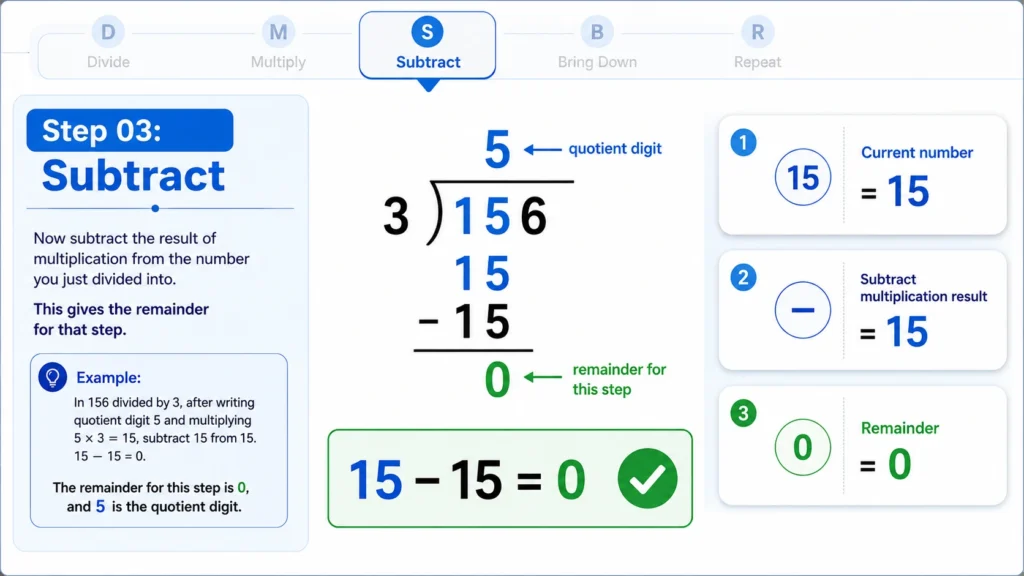
Step 03: Subtract:
Now subtract the result of multiplication from the number you just divided into. This gives you a remainder for that step.
For Example:
Now subtract 15 from 15, the remaining digit is 0. 0 is the remainder while 5 is quotient.
15 − 15 = 0
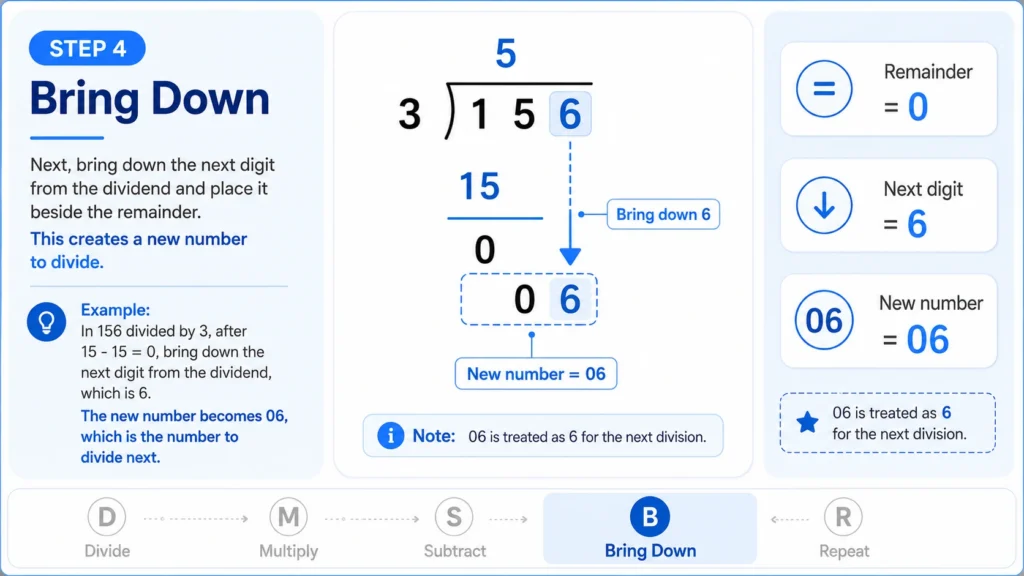
Step 4: Bring Down
Next, you bring down the next digit from the dividend and place it beside the remainder. This creates a new number to divide.
For Example:
Now we will bring down the next digit from the dividend, which is 6. Now the new number becomes 06 which we have to divide.
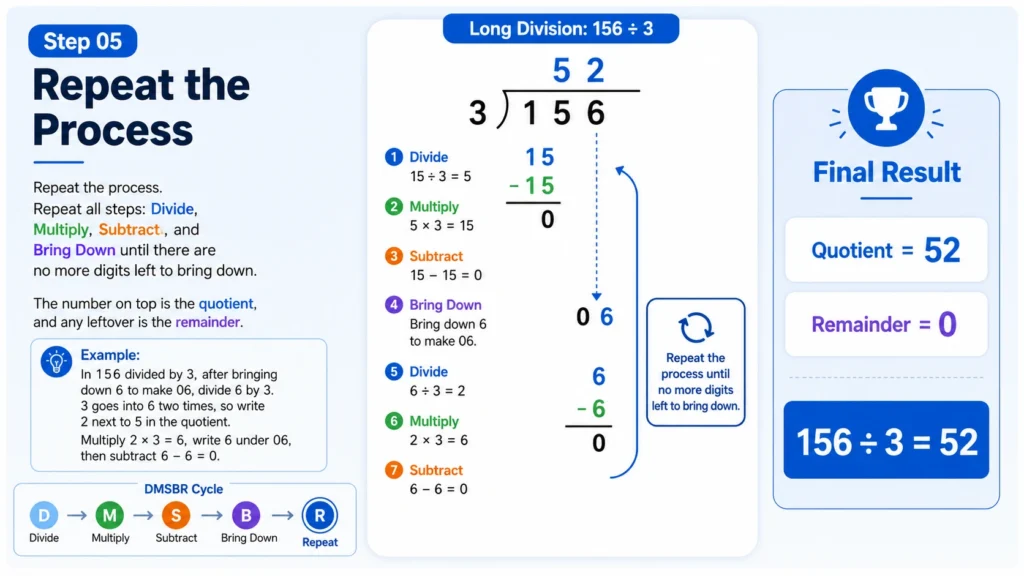
Step 05: Repeat the process
You repeat all the steps (Divide, Multiply, Subtract, Bring down) until there are no more digits left to bring down. The number on top is your quotient, and any leftover is the remainder.
For Example:
Now you’ll again divide the dividend 6 with divisor 3. 3 comes 2 times in 6 so 2 will go in quotient with 5 and after multiplication 6 goes right under 06, The next step is to subtract, the ans is 0. So the final result is quotient 52 and remainder 0.
Long Division Examples with Visuals
Let’s take a slightly longer example (987 ÷ 2) and go through all DMSBR steps clearly with visuals so that you can understand it more clearly. By understanding these steps, it is impossible to do wrong division ever.
Step: 01
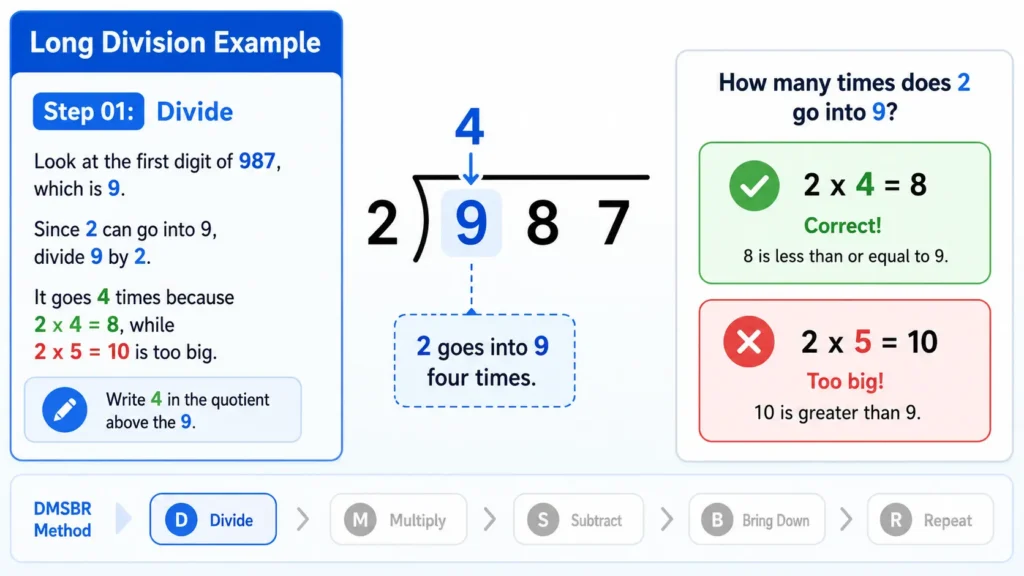
We will start by looking at the first digit of 987, which is 9. Since 2 can go into 9, we divide 9 by 2. It goes 4 times because 2 × 4 = 8, and 2 × 5 = 10 is big. So, we write 4 in the quotient above the 9.
Step: 02
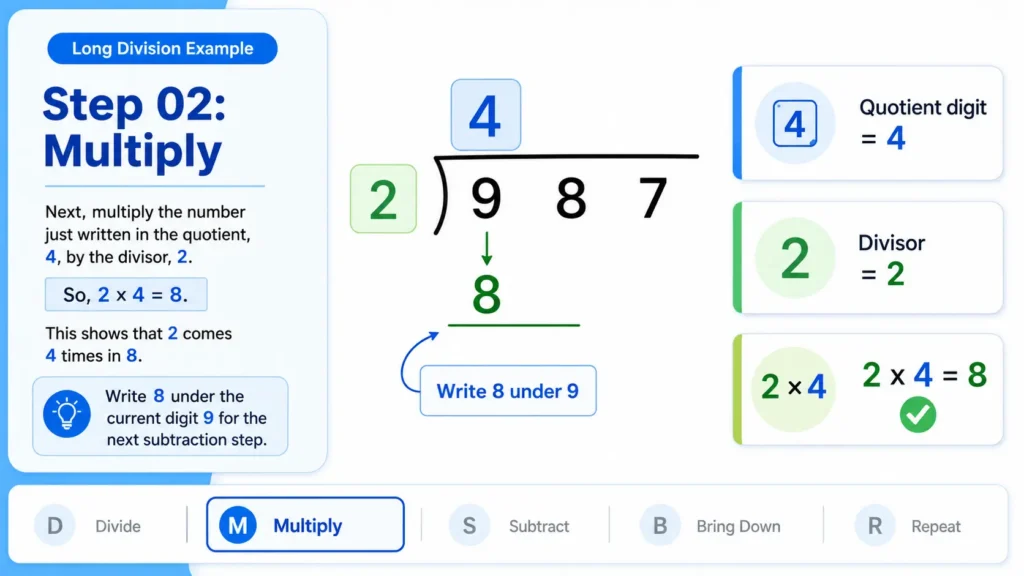
Next, we will multiply the number we just wrote (4) by the divisor (2). So, 2 × 4 = 8. This shows 2 comes 4 times in 8.
Step: 03
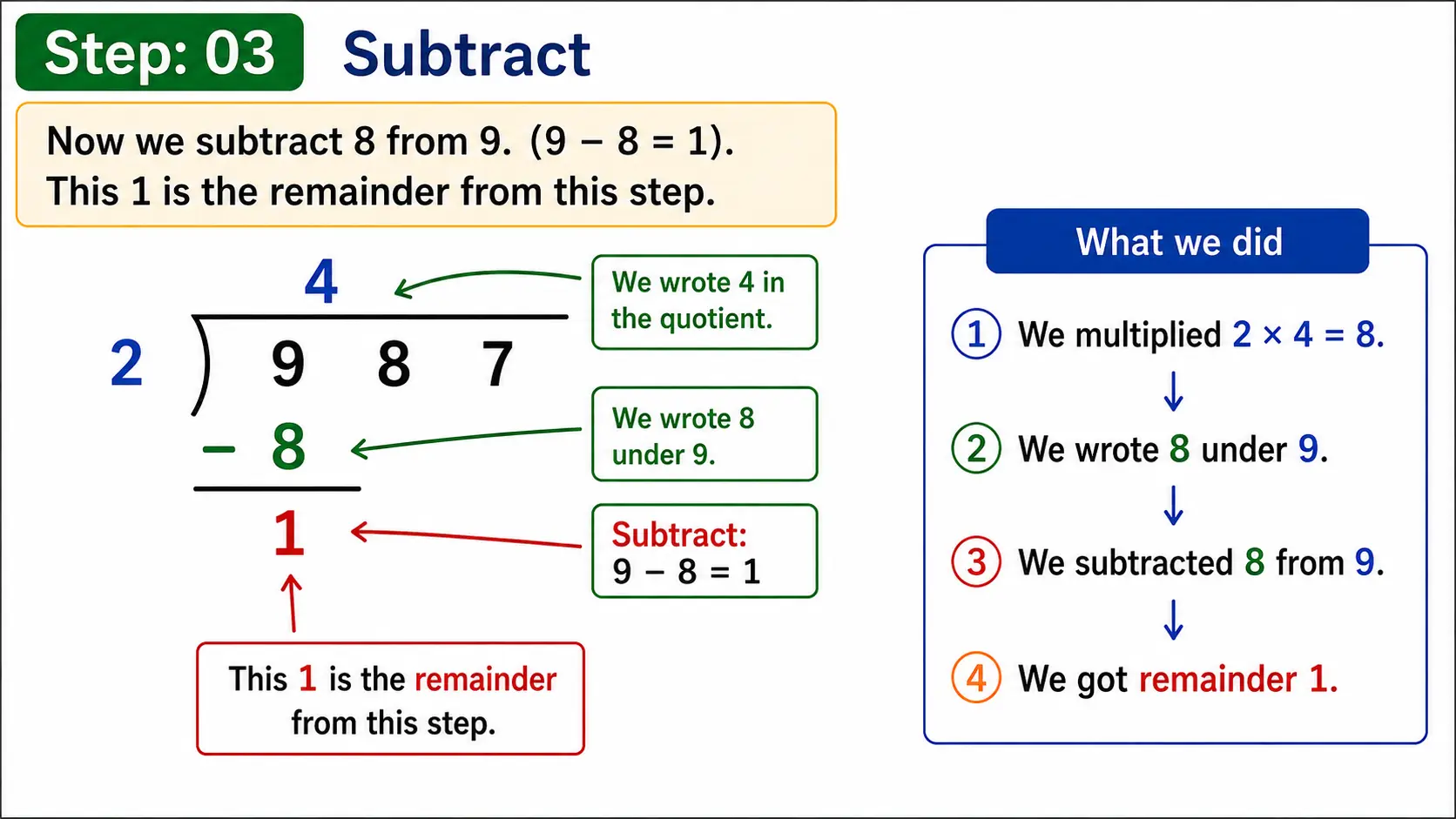
Now we subtract 8 from 9. (9 − 8 = 1). This 1 is the remainder from this step.
Step: 04
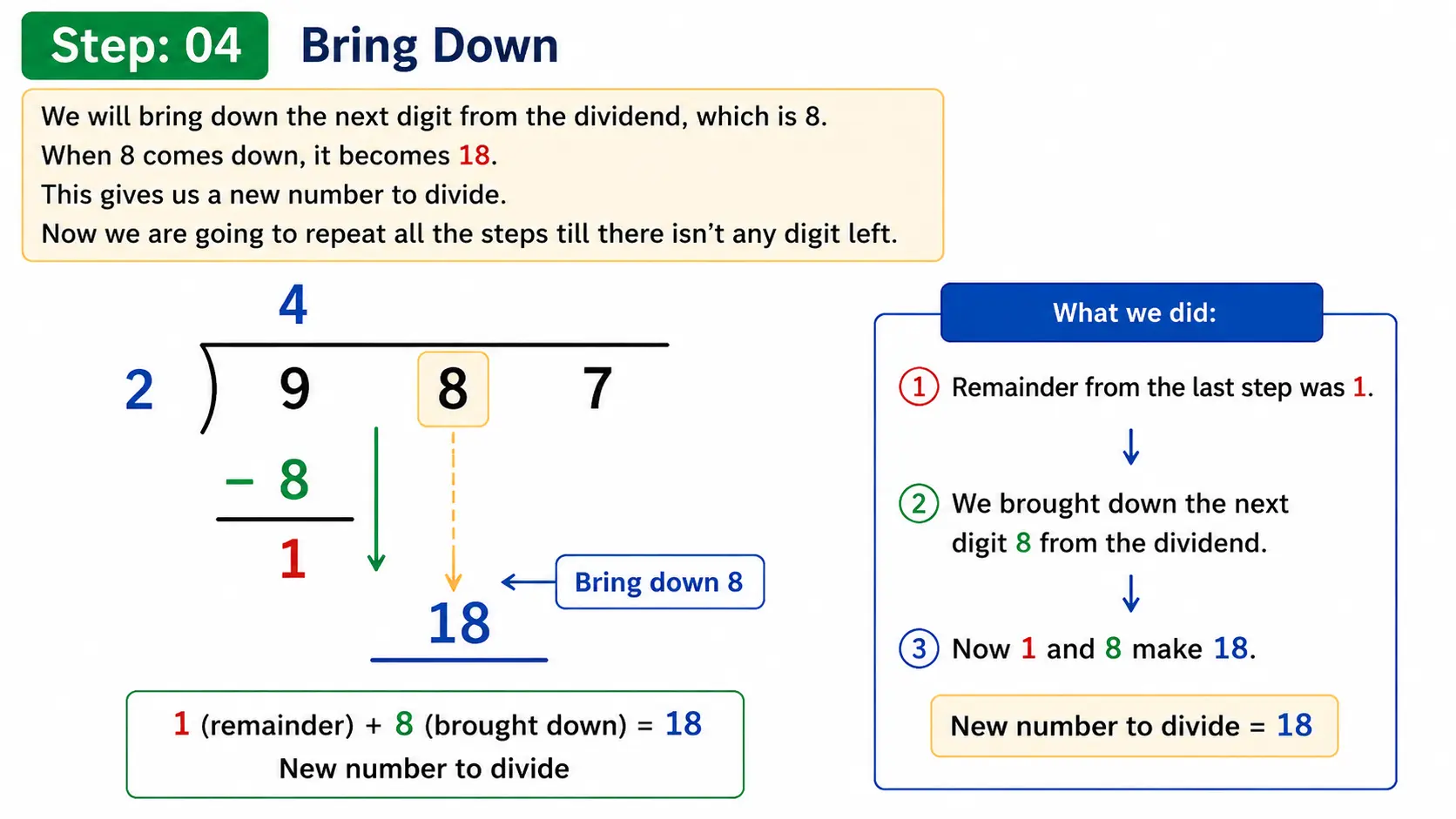
We will bring down the next digit from the dividend, which is 8. When 8 comes ,it becomes 18. This gives us a new number to divide. Now we are going to repeat all the steps till there isn’t any digit left.
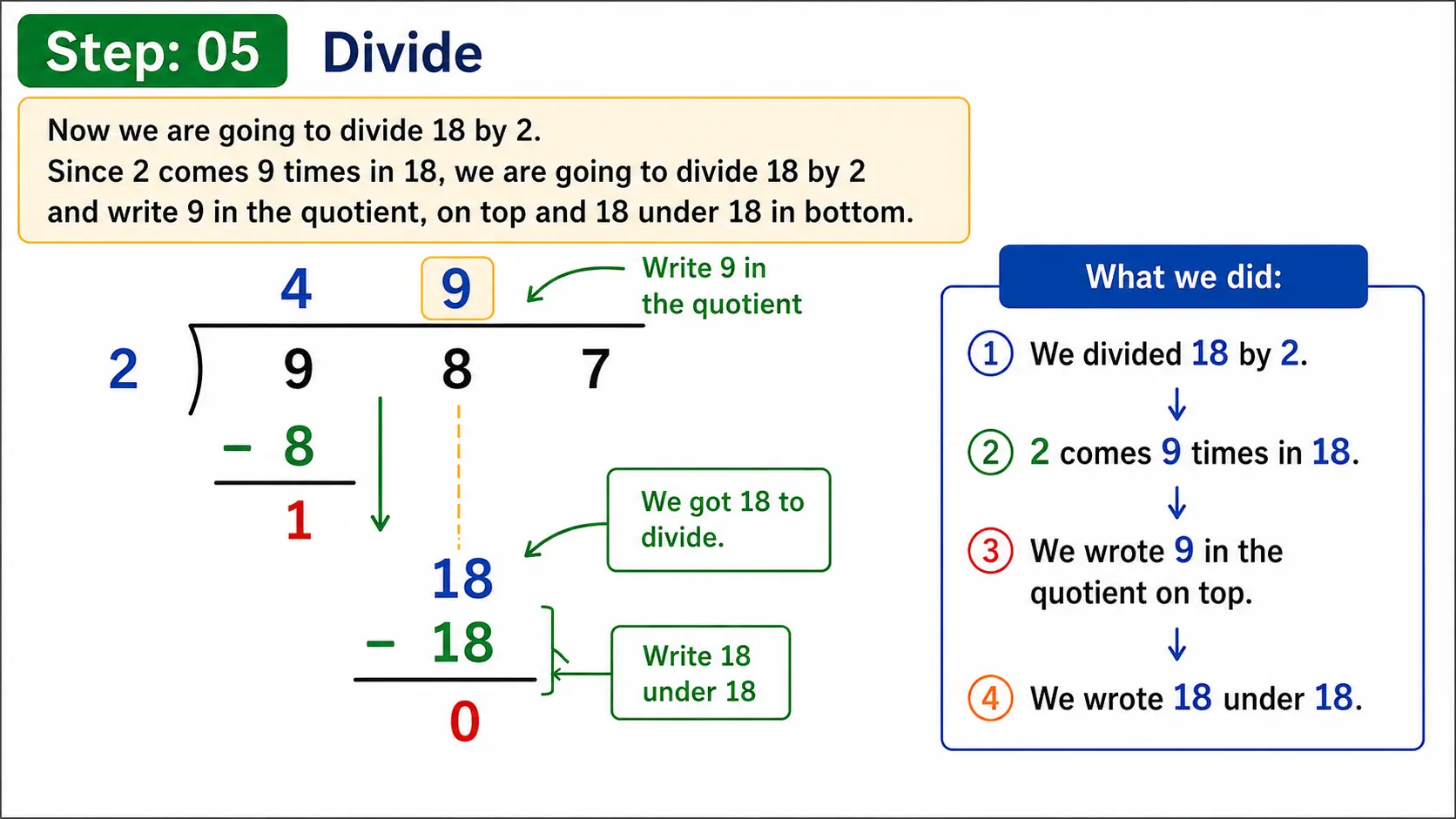
Step: 05
Now we are going to divide 18 by 2. Since 2 comes 9 times in 18, we are going to divide 18 by 2 and write 9 in the quotient, on top and 18 under 18 in bottom.
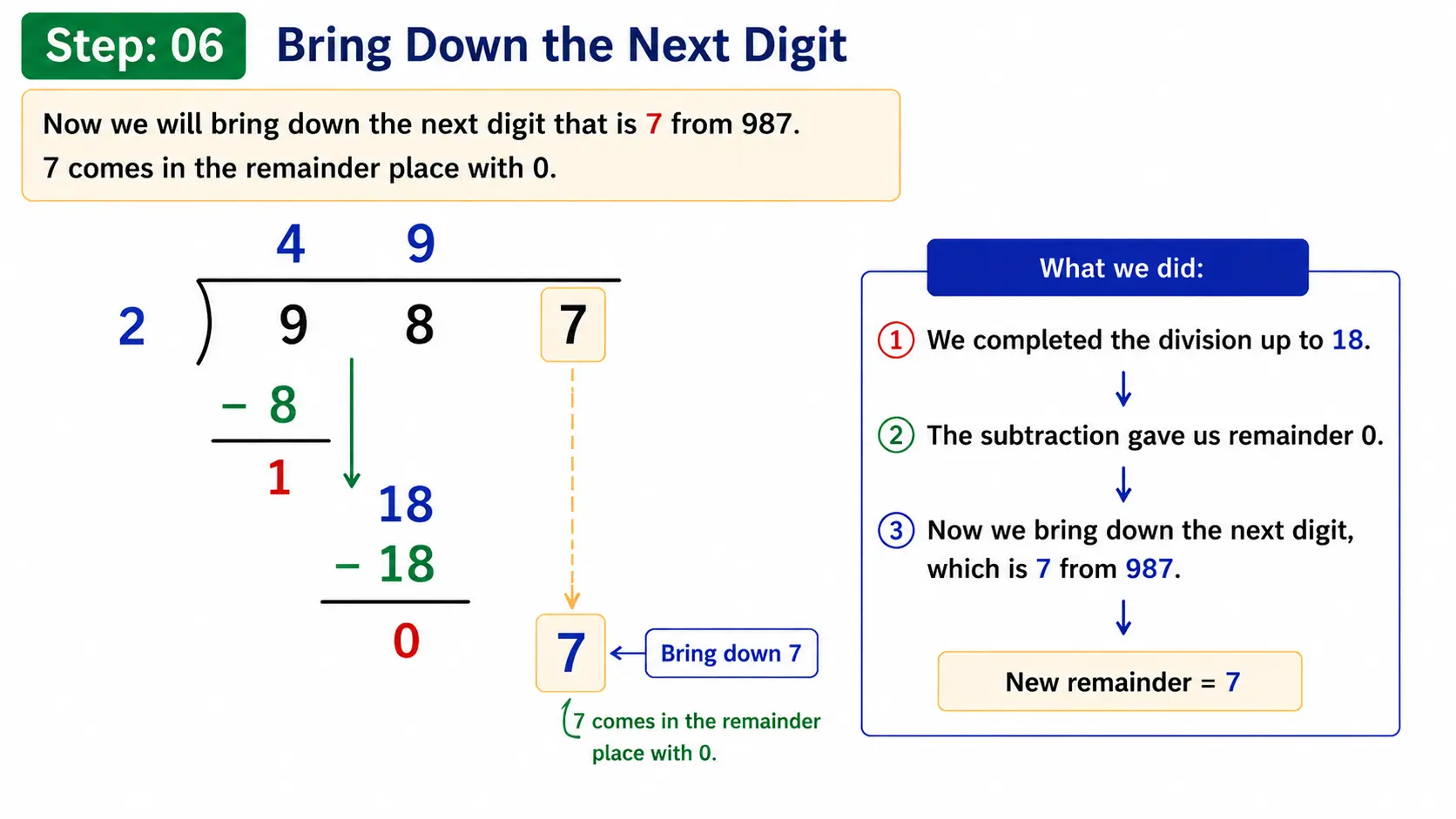
Step: 06
Now we will bring down the next digit that is 7 from 987. 7 comes in the remainder place with 0.
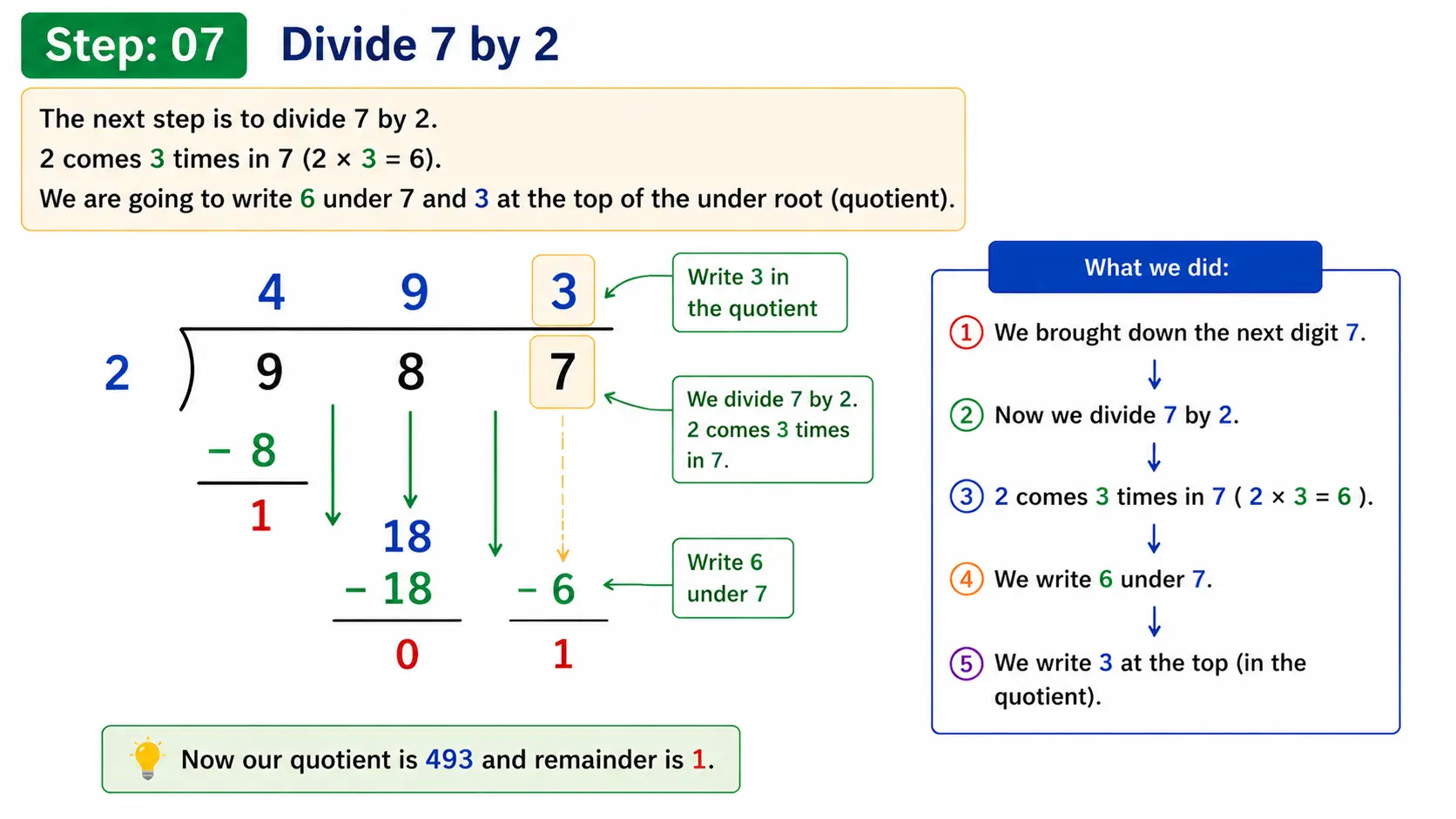
Step: 07
The next step is to divide 7 by 2. 2 comes 3 times in 7 ( 2×3=6). We are going to write 6 under 7 and 3 at the top of the under root(quotient).
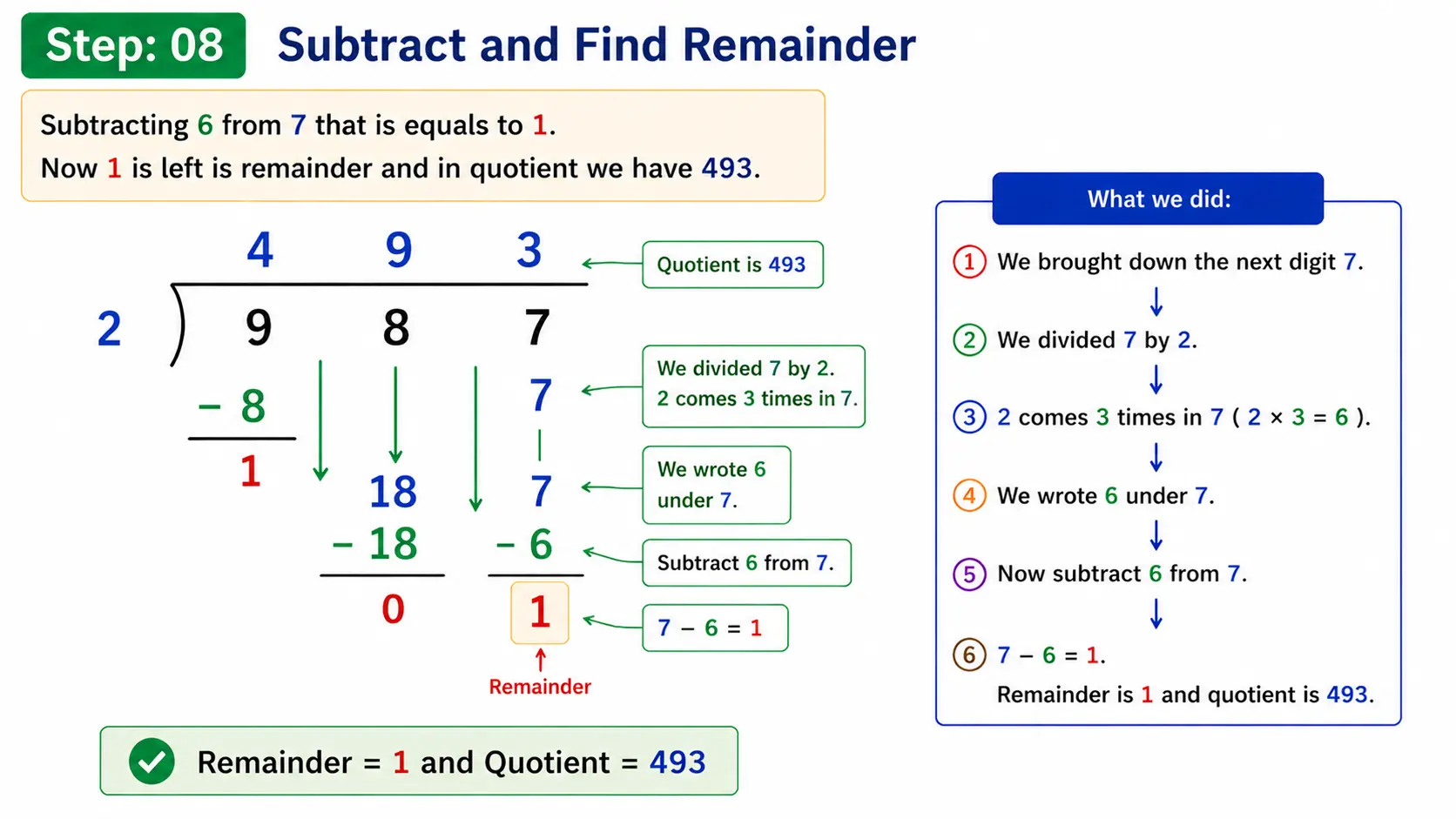
Step:08
Subtracting 6 from 7 that is equals to 1. Now 1 is left is remainder and in quotient we have 493.
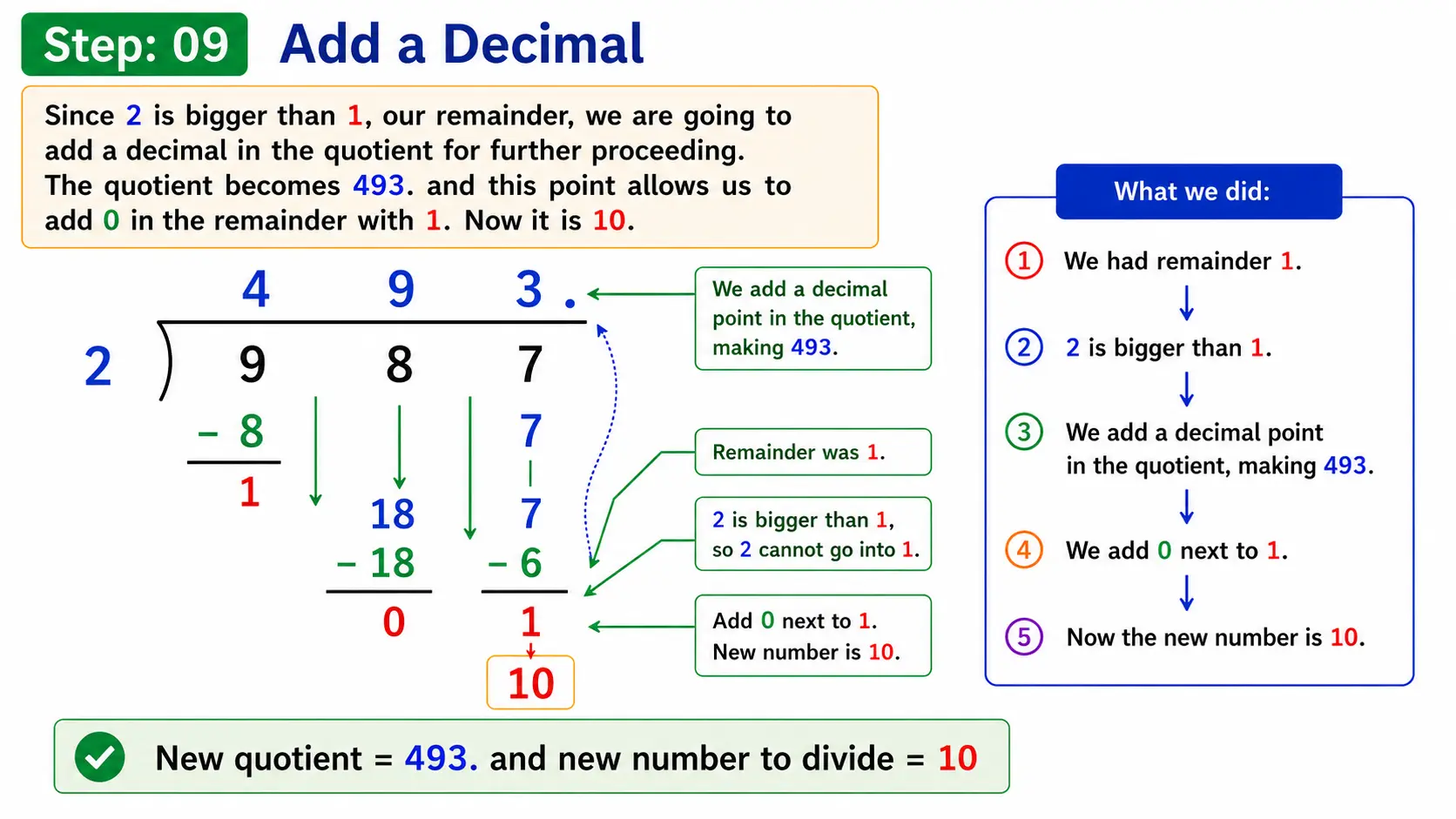
Step: 9
Since 2 is bigger than one, our remainder, we are going to add decimal in quotient for further proceeding. The quotient becomes (493.) and this point allows us to add 0 in the remainder with 1. Now it is 10.
Step: 10
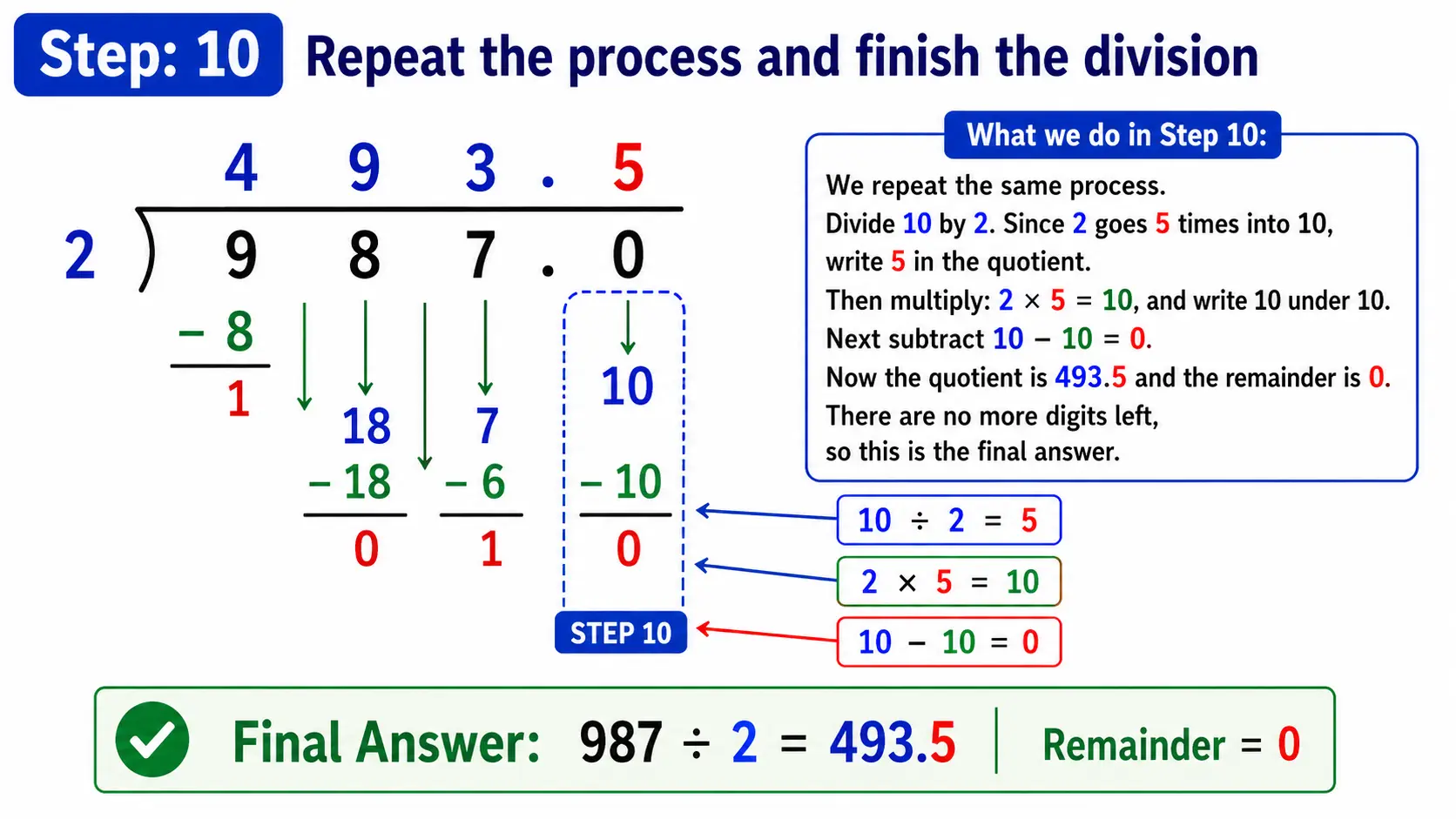
Repeating the same process. We will divide 10 by 2, 2 comes 5 times under 10. So 5 goes at the top in quotient while 2×5=10, 10 goes right under the remainder 10. The next step is subtraction. Subtracting 10 by 10 results in 0.
Now the quotient is 493.5 and remainder is 0. There isn’t any more digit to divide so this is our final answer.
How to Find the Quotient and Remainder using Long Division
It is simple to find the quotient and remainder using long division, as we discussed in the steps earlier. At each step, we see how many times the divisor fits into the current number and write that result as part of the quotient. Then we multiply, subtract, and bring down the next digit and repeat the same process. The final number written on top is the quotient, and the remaining value at the end is the remainder.
How Many Zero’s can we add in Long Division
In long division, you can add as many zeros as needed depending on the situation. After dividing the whole numbers you didn’t get the evenly answer, you can add zeros after the decimal point in the dividend to continue dividing and get a more precise answer. There is no fixed limit to how many zeros you can add, you keep adding them until the remainder becomes zero or until you reach the required level of accuracy.
Conclusion
Long division is a simple but powerful method that helps us break large numbers into smaller in easier steps. By carefully following the DMSBR process; divide, multiply, subtract, bring down, and repeat, we can find accurate answers in an organized way. Now you can use our tool more precisely after understanding how the long division works.
Frequently Asked Questions(FAQs)
Q1: Is the first decimal the remainder?
No, the first decimal is not the remainder. It is just a way to continue division when you bring down zeros after the decimal point.
Q2: What are the five basic steps of long division?
The five basic steps of long division are: Divide, Multiply, Subtract, Bring Down, and Repeat. These steps are followed in order until the division is complete and the quotient and remainder are found.
Q3: How to do long division if there are two digits?
When doing long division with a two-digit divisor, you follow the same steps as normal long division. First, take enough digits from the dividend so that the number is greater than or equal to the divisor. Then divide, multiply, subtract, and bring down the next digit just like before.
Q4: How do we calculate the dividend from the quotient, remainder, and divisor?
To calculate the dividend from the quotient, remainder, and divisor, we use a simple formula. First, multiply the divisor by the quotient to get a partial value. Then add the remainder to that result. This gives you the original dividend. In short, the dividend is equal to (divisor × quotient) + remainder.