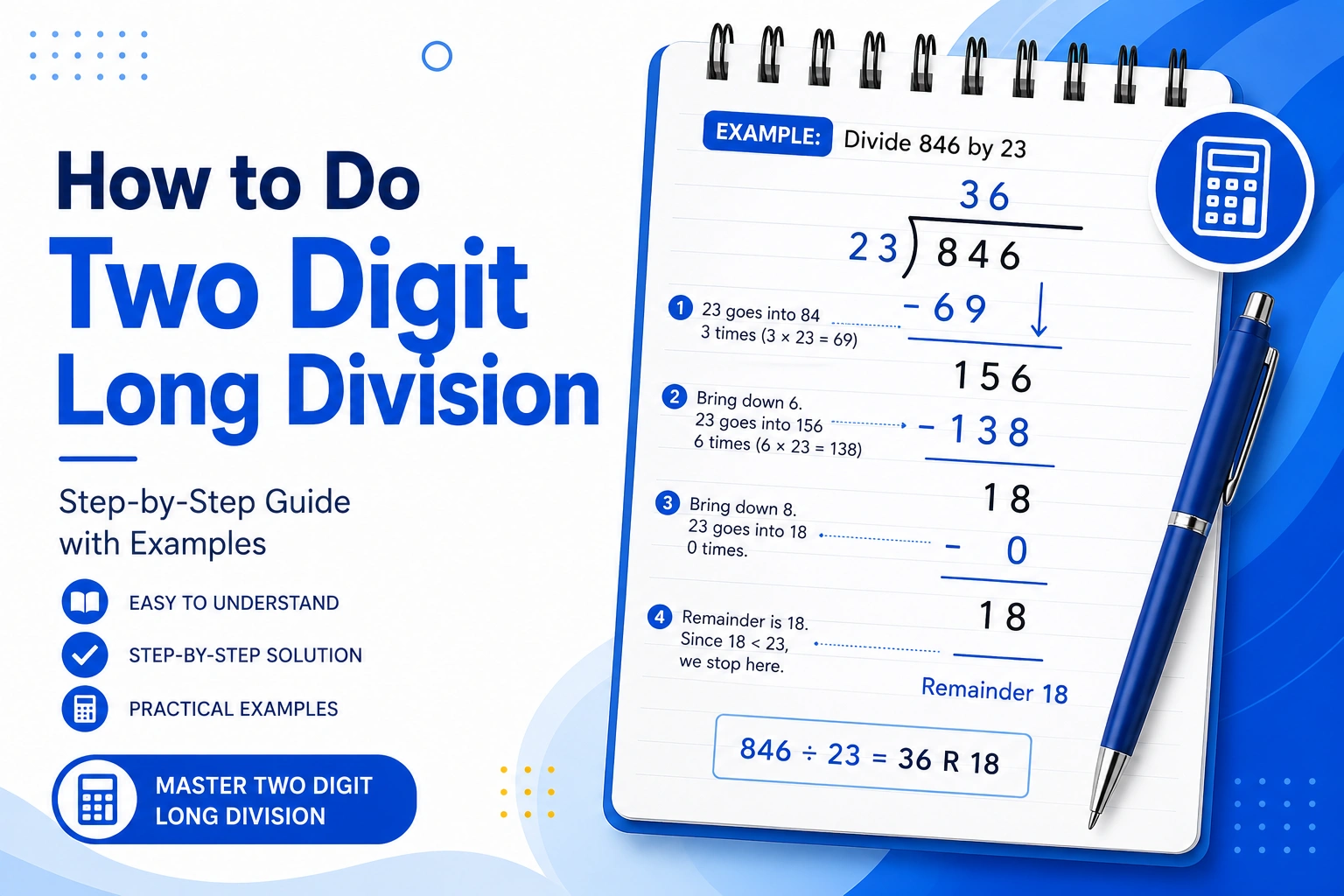
How to Do Two Digit Long Division
Introduction
When you hear about dividing by two digits, it seems harder than dividing by one digit.The idea behind the division is always the same whether you are dividing by one, two or three digits, breaking down bigger numbers to get the results. In this guide, we will help you with the rules, steps and mistakes about the two digit division. If you want to check your answers while practicing, you can use our Long Division Calculator to verify your solutions instantly.
Rules Before Dividing
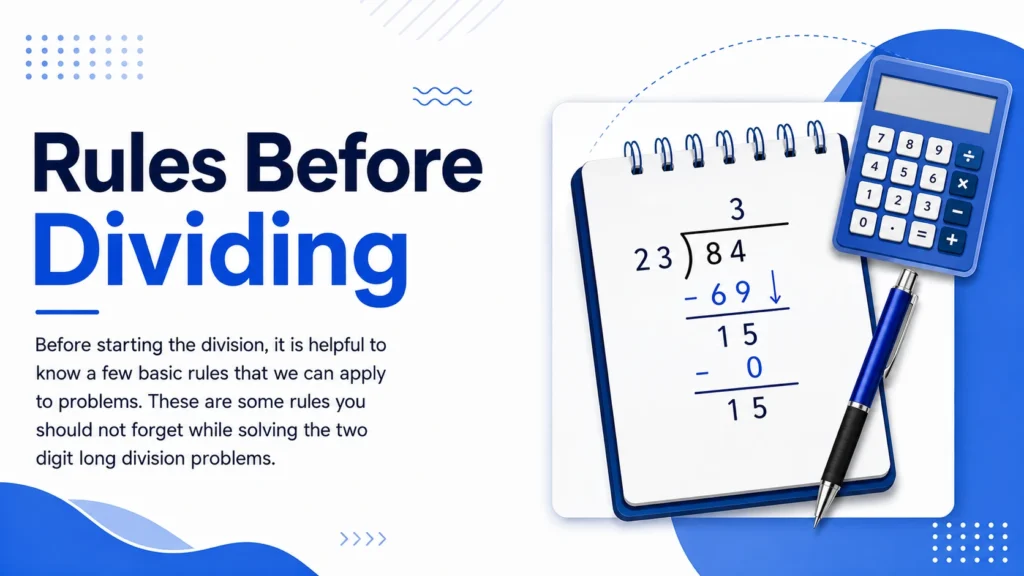
Before starting the division, it is helpful to know a few basic rules that we can apply to problems. These are some rules you should not forget while solving the two digit long division problems.
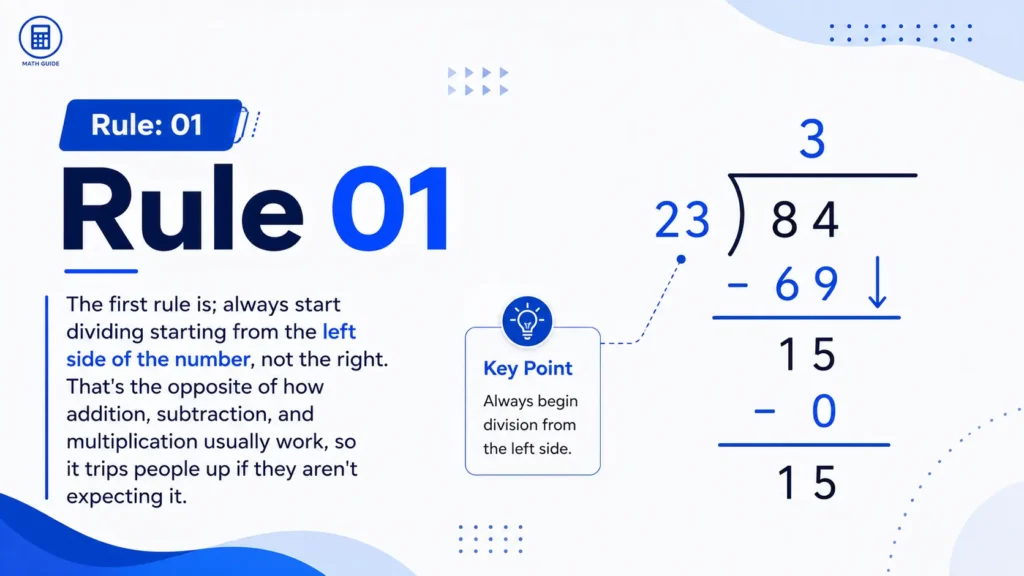
Rule:01
The first rule is; always start dividing starting from the left side of the number, not the right. That’s the opposite of how addition, subtraction, and multiplication usually work, so it trips people up if they aren’t expecting it.
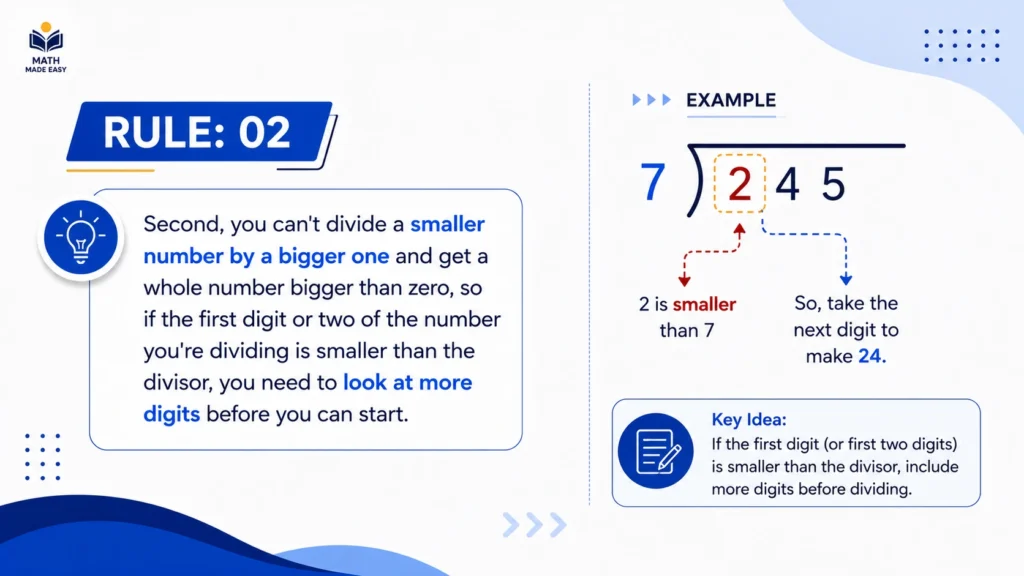
Rule:02
Second, you can’t divide a smaller number by a bigger one and get a whole number bigger than zero, so if the first digit or two of the number you’re dividing is smaller than the divisor, you need to look at more digits before you can start.
Rule:03
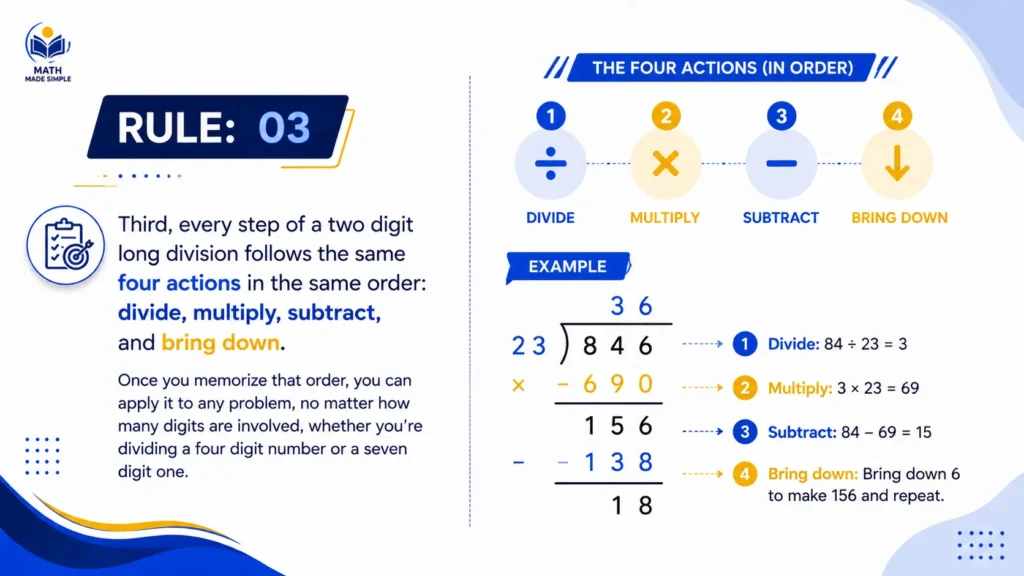
Third, every step of a two digit long division follows the same four actions in the same order: divide, multiply, subtract, and bring down. Once you memorize that order, you can apply it to any problem, no matter how many digits are involved, whether you’re dividing a four digit number or a seven digit one. This same DMSBR method is explained in detail in our complete guide on how to do long division, where each step is shown with examples.
Rule:04
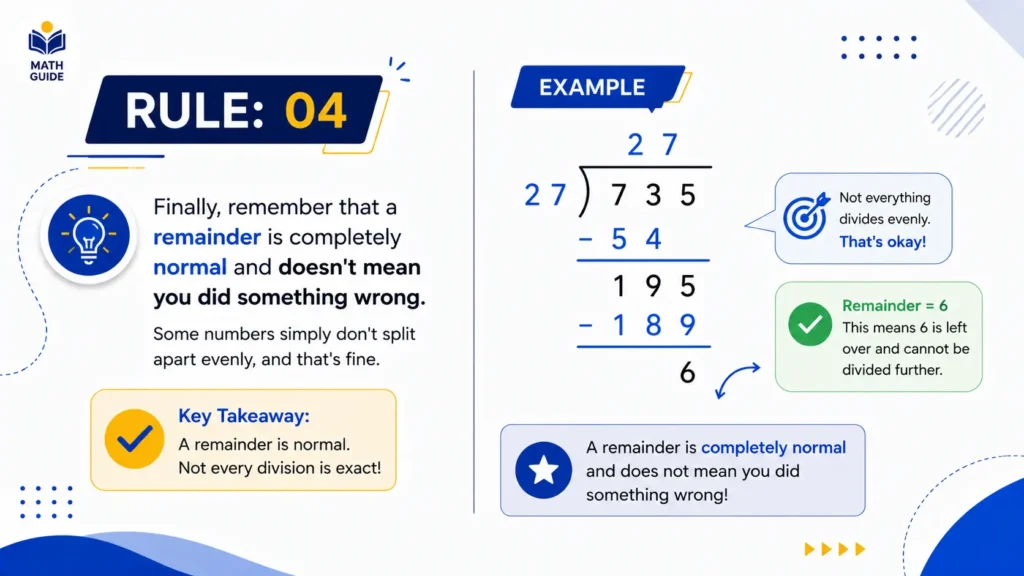
Finally, remember that a remainder is completely normal and doesn’t mean you did something wrong. Some numbers simply don’t split apart evenly, and that’s fine.
Dividend and Divisor
There are two most important things you should know. The number being divided is called the dividend, and the number doing the dividing is called the divisor.
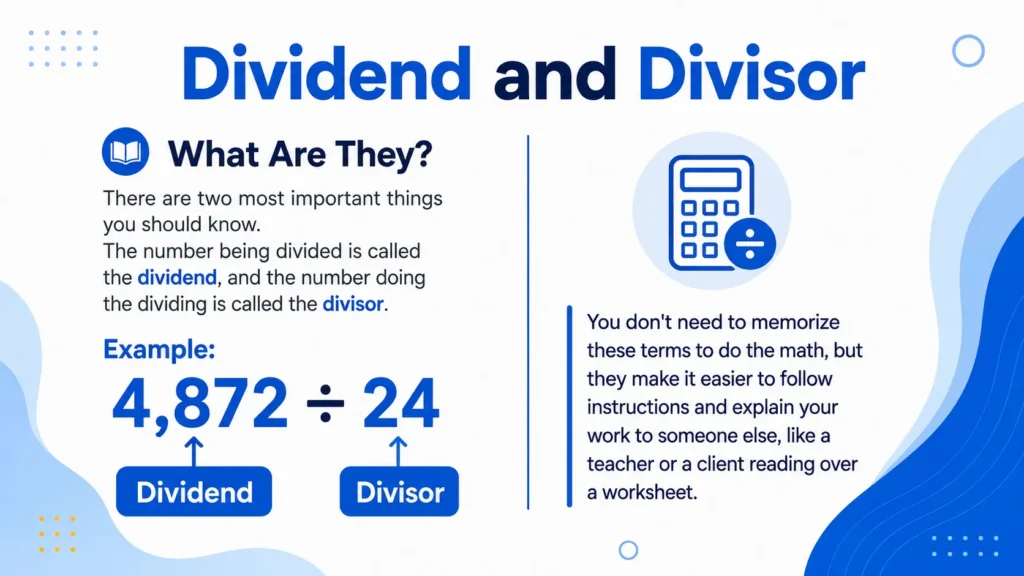
You don’t need to memorize these terms to do the math, but they make it easier to follow instructions and explain your work to someone else, like a teacher or a client reading over a worksheet. Understanding these basic terms will also help when solving different types of division problems, including problems with larger numbers.
Important Things to Keep in Mind
A few habits make two digit long division much easier and help you avoid getting lost partway through a problem.

Neat Columns
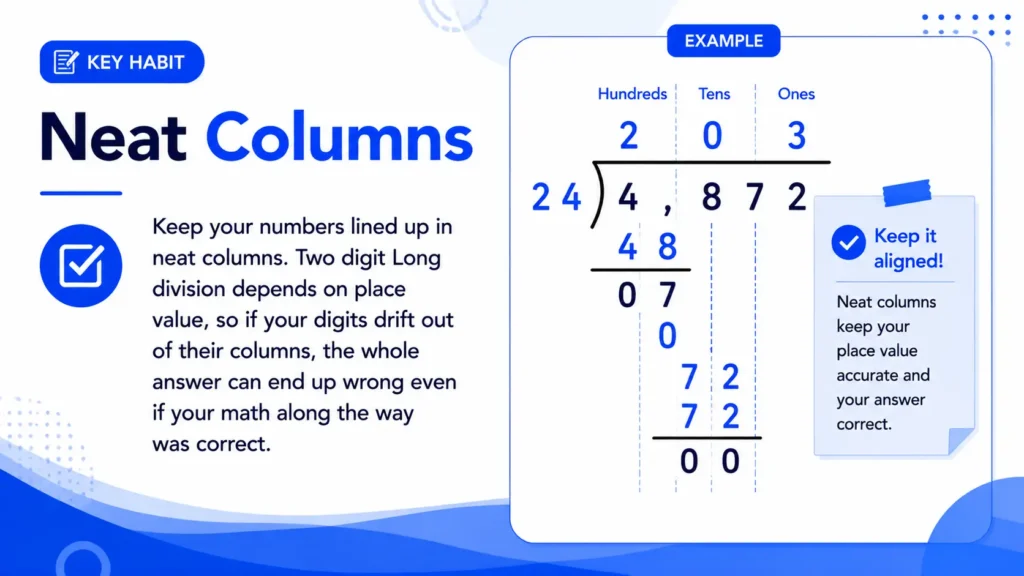
Keep your numbers lined up in neat columns. Two digit Long division depends on place value, so if your digits drift out of their columns, the whole answer can end up wrong even if your math along the way was correct.
Rounding the divisor
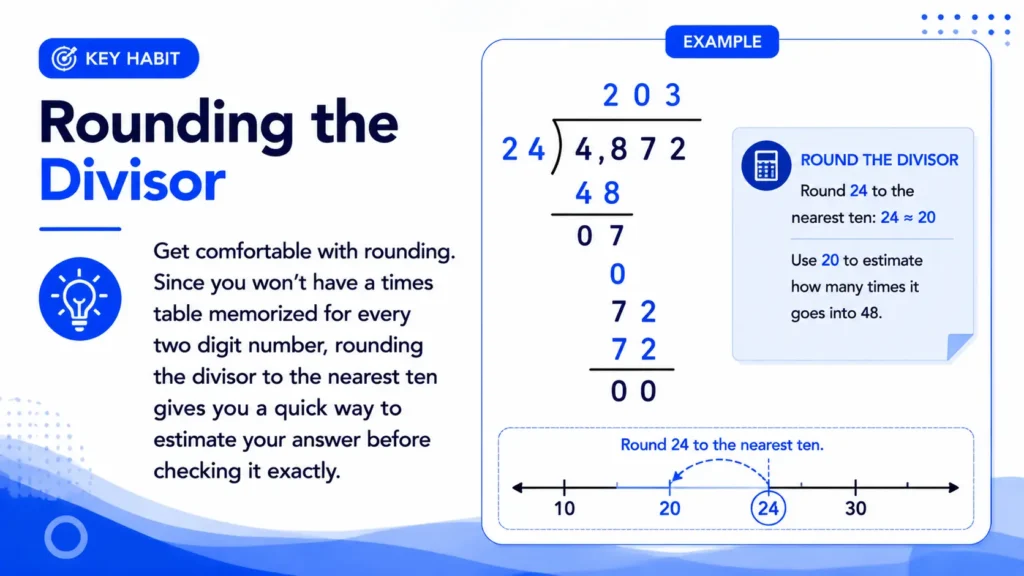
Get comfortable with rounding. Since you won’t have a times table memorized for every two digit number, rounding the divisor to the nearest ten gives you a quick way to estimate your answer before checking it exactly. Estimation becomes even more useful when solving larger problems because it helps you quickly find how many times a divisor fits into a dividend.
Guess Work
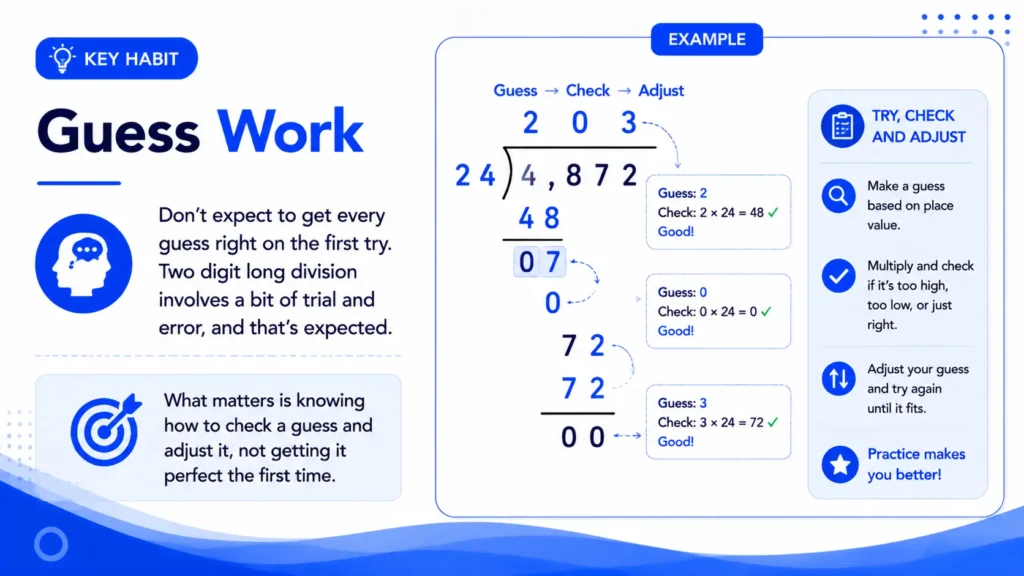
Don’t expect to get every guess right on the first try. Two digit long division involves a bit of trial and error, and that’s expected. What matters is knowing how to check a guess and adjust it, not getting it perfect the first time.
Write on paper
It also helps to work on scratch paper or in the margin before committing to an answer. Note down a couple of multiples of the divisor off to the side, so you’re not doing every multiplication in your head.
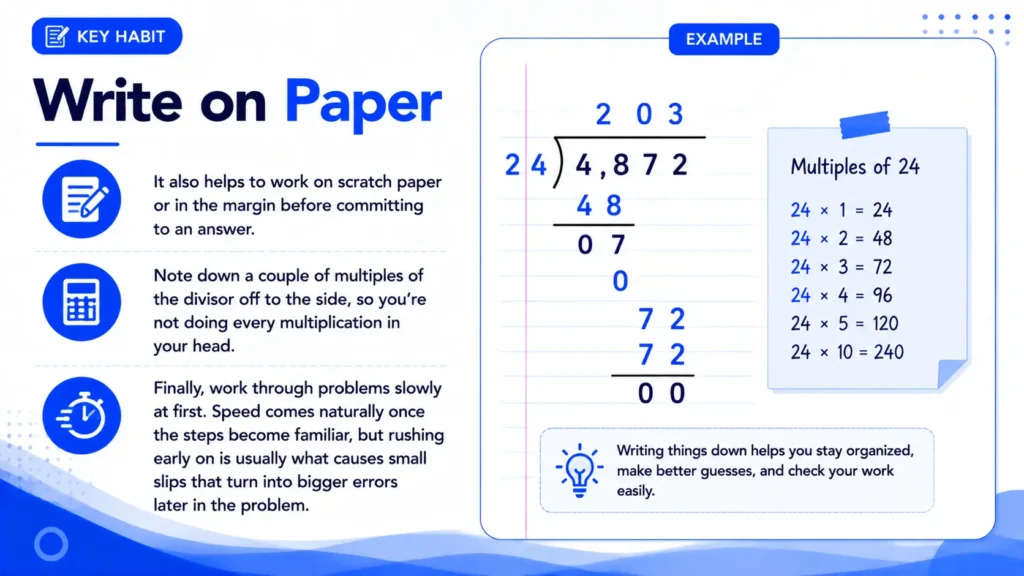
Finally, work through problems slowly at first. Speed comes naturally once the steps become familiar, but rushing early on is usually what causes small slips that turn into bigger errors later in the problem.
Step-by-Step Method for Two Digit Long Division
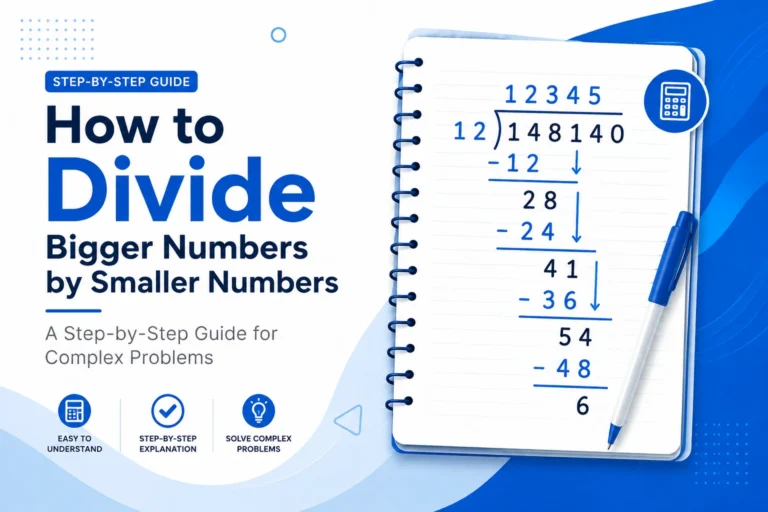
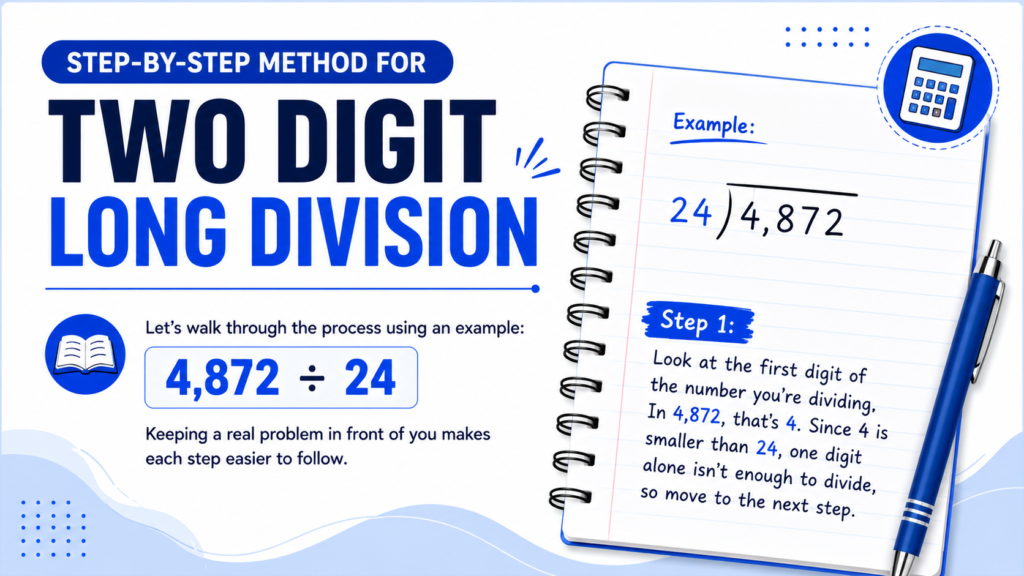
Let’s walk through the process using an example: 4,872 divided by 24. Keeping a real problem in front of you makes each step easier to follow.
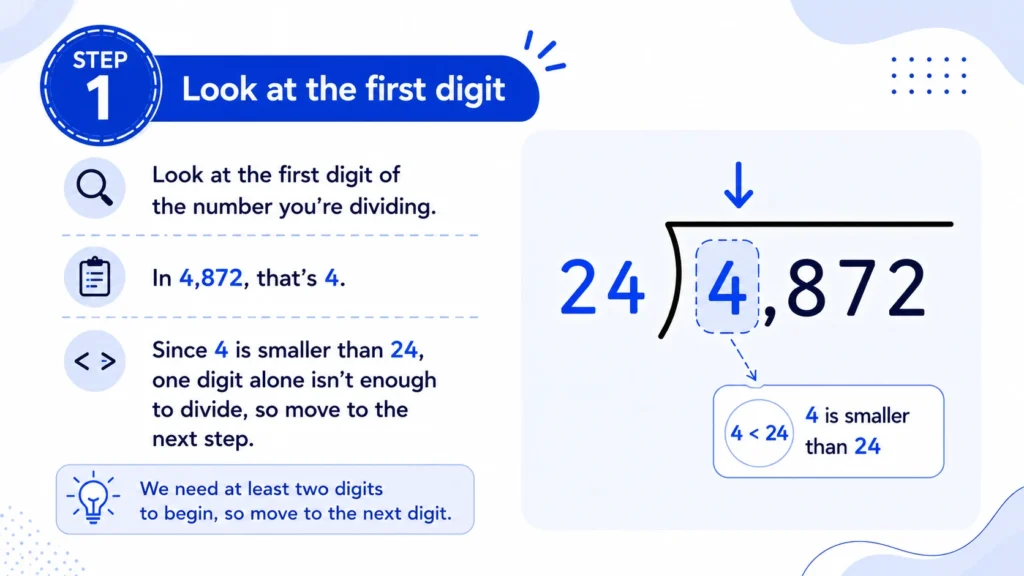
Step 1:
Look at the first digit of the number you’re dividing. In 4,872, that’s 4. Since 4 is smaller than 24, one digit alone isn’t enough to divide, so move to the next step.
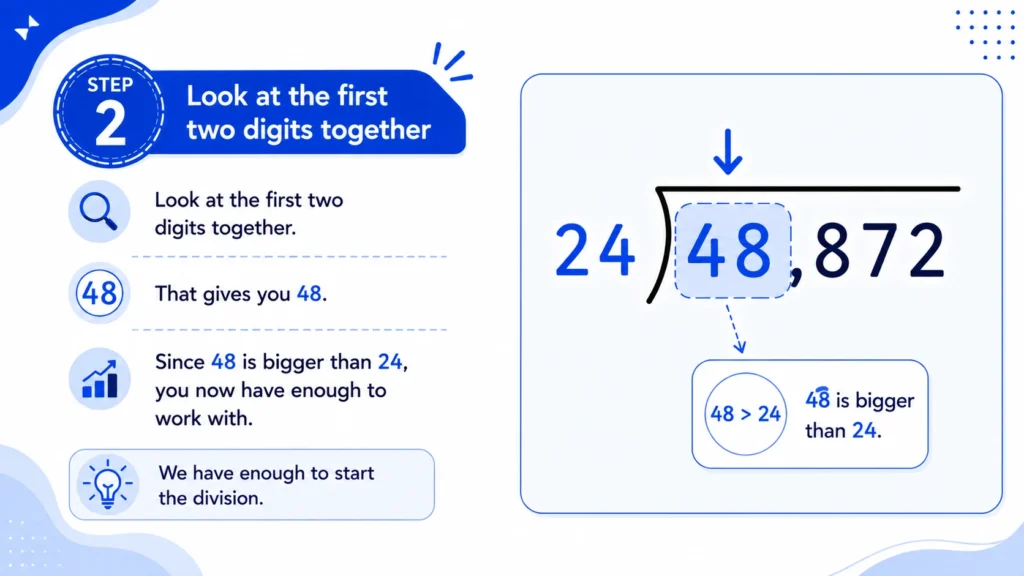
Step 2:
Look at the first two digits together. That gives you 48. Since 48 is bigger than 24, you now have enough to work with.
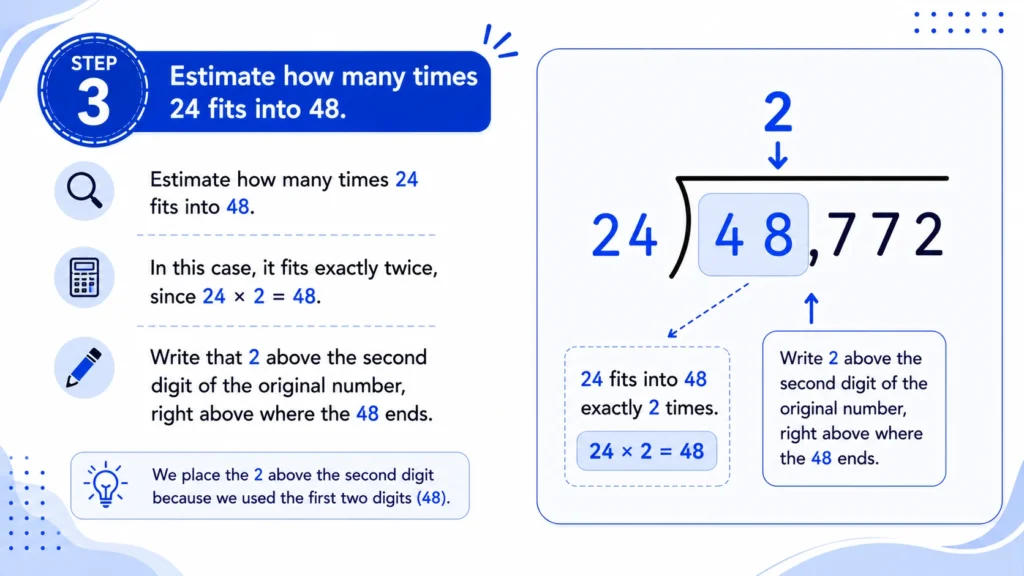
Step 3:
Estimate how many times 24 fits into 48. In this case, it fits exactly twice, since 24 times 2 equals 48. Write that 2 above the second digit of the original number, right above where the 48 ends.
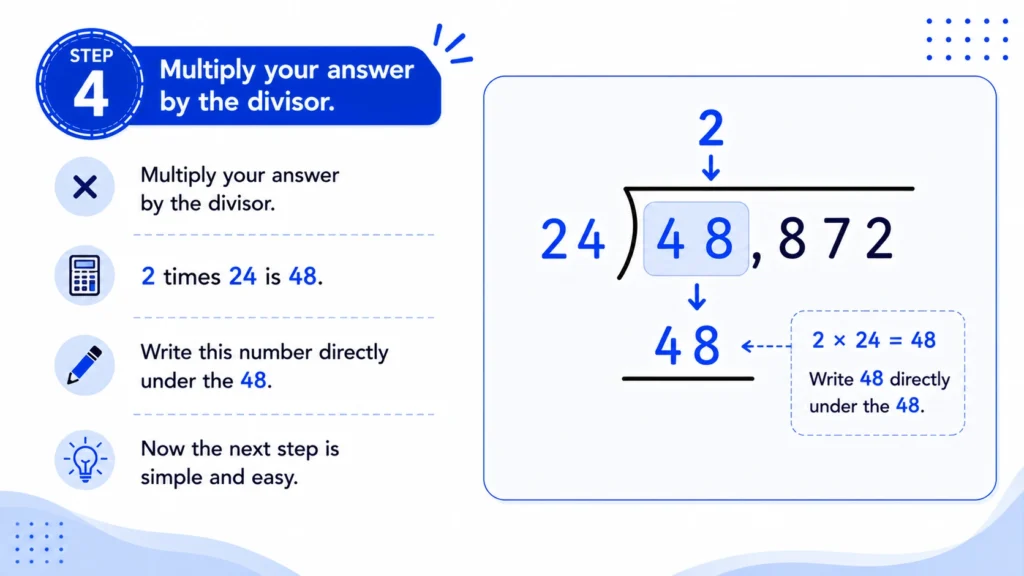
Step 4:
Multiply your answer by the divisor. 2 times 24 is 48. Write this number directly under the 48. Now the next step is simple and easy.
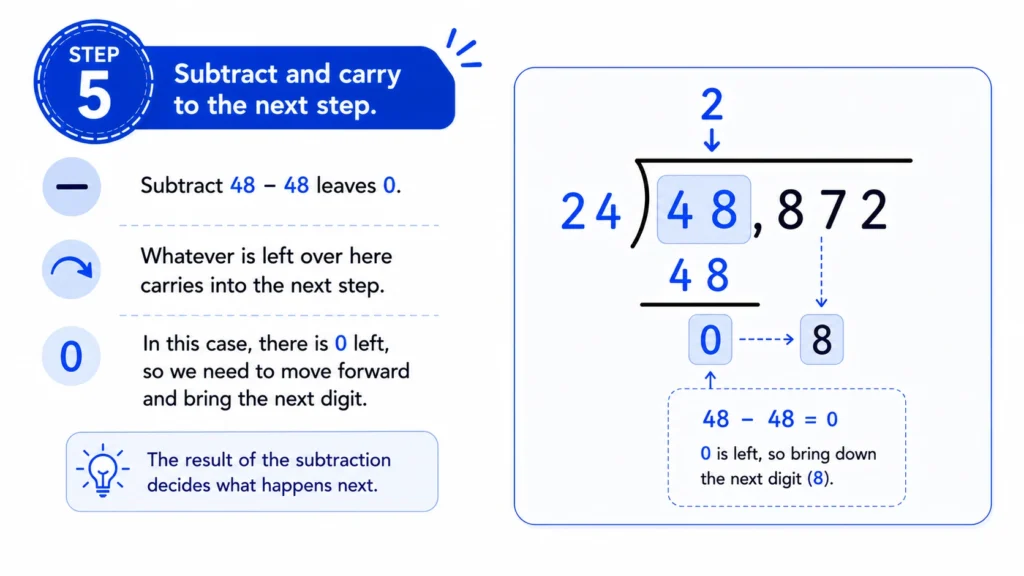
Step 5:
Subtract 48 minus 48 leaves 0. Whatever is left over here carries into the next step. Now in this case, there is 0 left so we need to move forward and bring the next digit.\
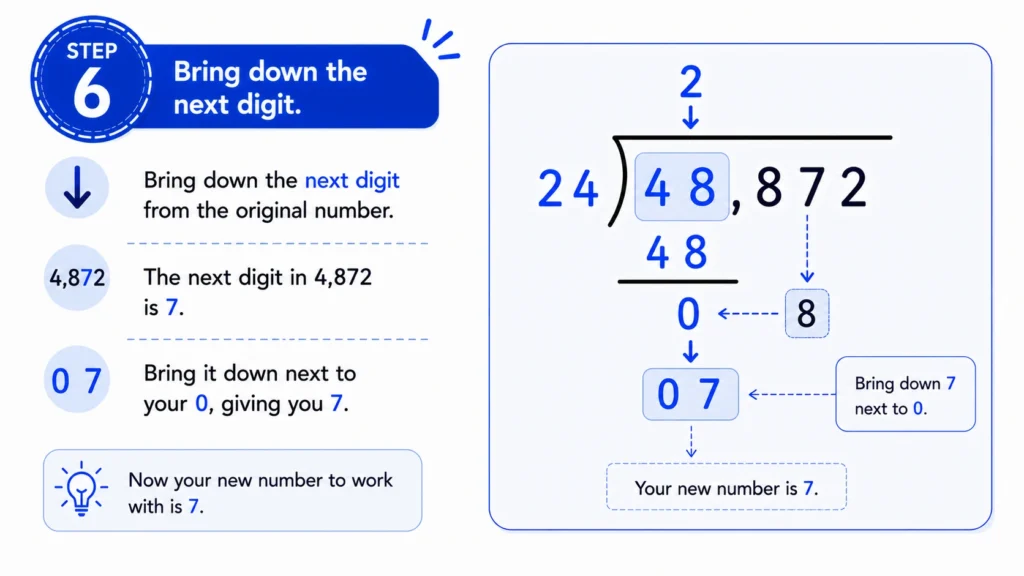
Step 6:
Bring down the next digit from the original number. The next digit in 4,872 is 7, so bring it down next to your 0, giving you 7.
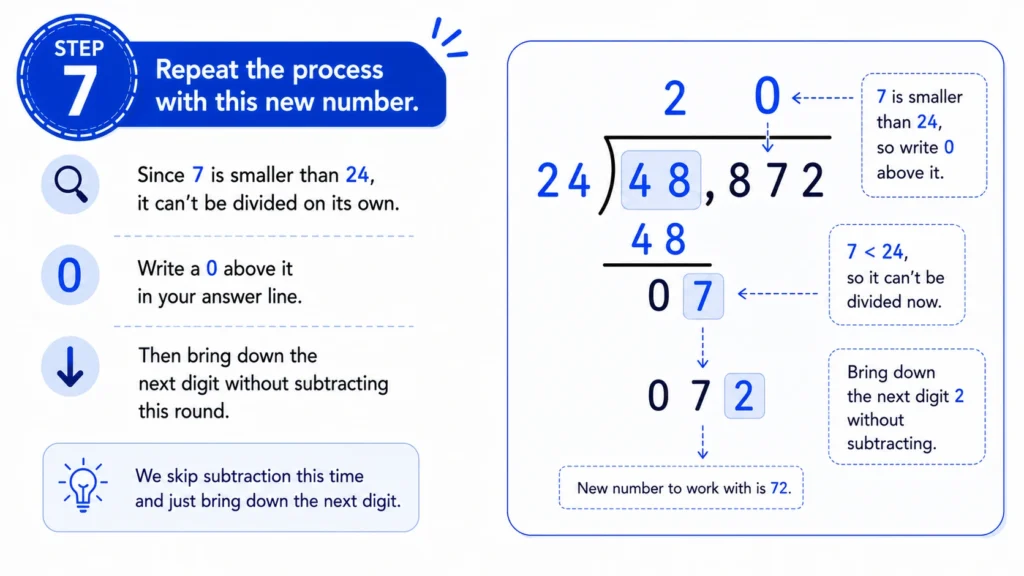
Step 7:
Repeat the process with this new number. Since 7 is smaller than 24, it can’t be divided on its own, so write a 0 above it in your answer line, then bring down the next digit without subtracting this round.
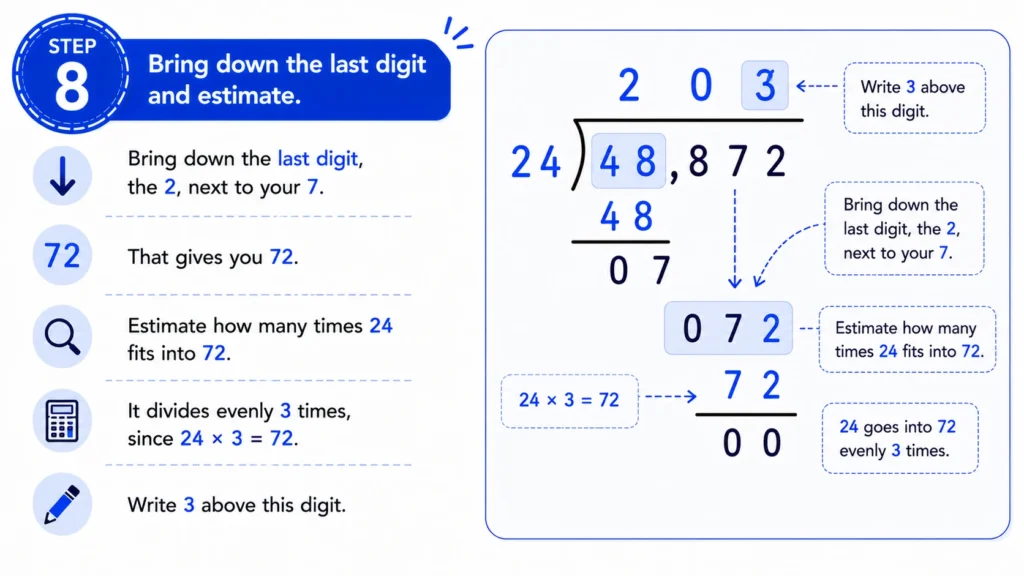
Step 8:
Bring down the last digit, the 2, next to your 7. That gives you 72. Estimate how many times 24 fits into 72. It divides evenly 3 times, since 24 times 3 is 72. Write 3 above this digit.
Step 9:
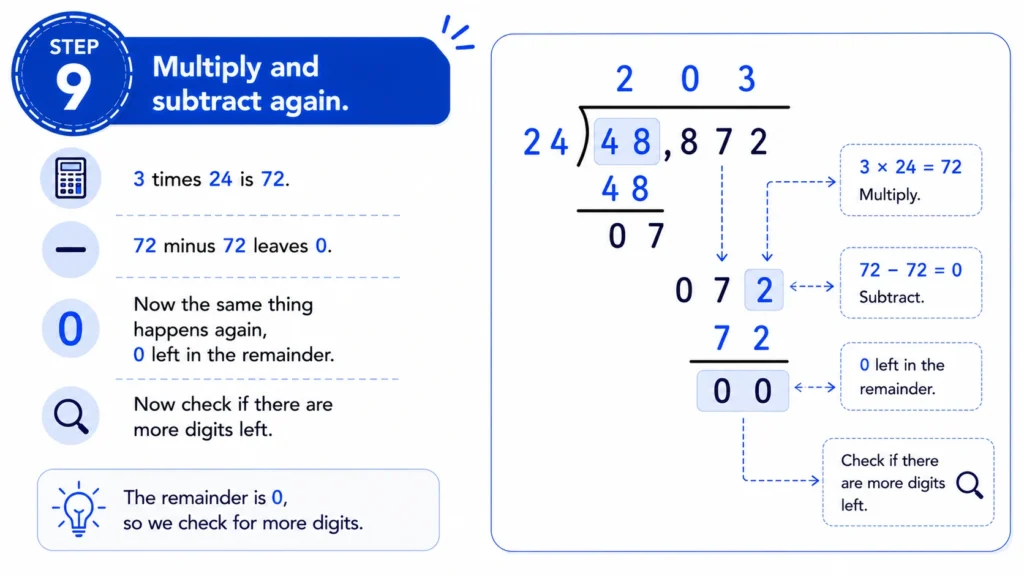
Multiply and subtract again. 3 times 24 is 72, and 72 minus 72 leaves 0. Now the same thing happens again, 0 left in the remainder. Now check if there are more digits left.
Step 10:
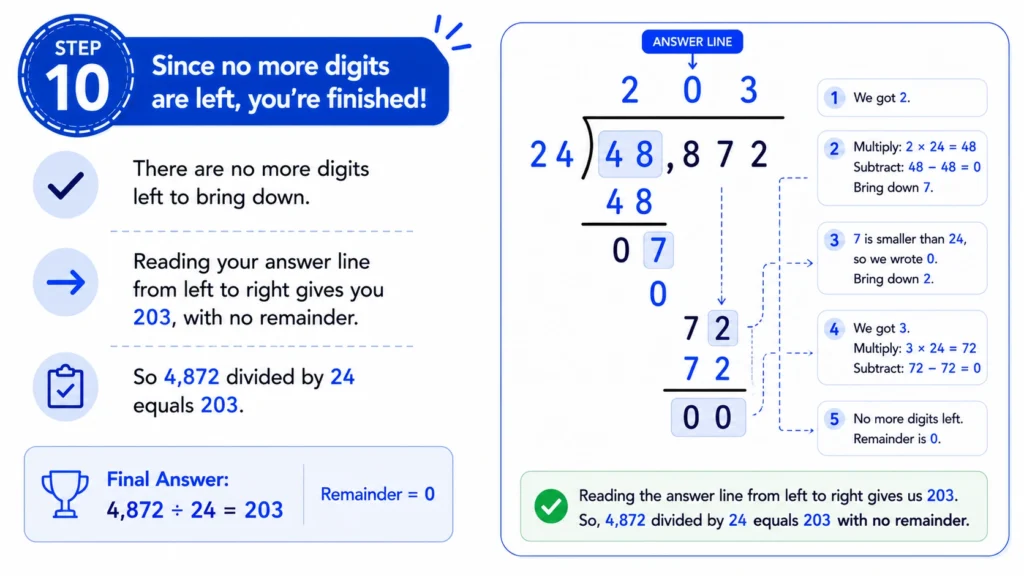
Since there are no more digits left to bring down, you’re finished. Reading your answer line from left to right gives you 203, with no remainder. So 4,872 divided by 24 equals 203.
Final Answer
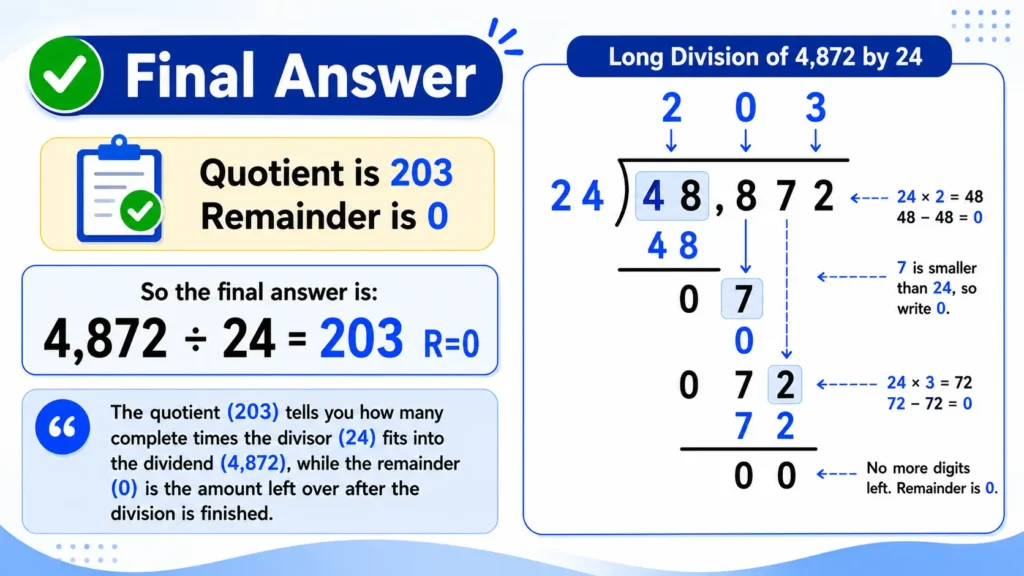
Quotient is 203 and Remainder is 0 so the final answer is 48,872 ÷ 24 = 203 R =0. The quotient tells you how many complete times the divisor fits into the dividend, while the remainder is the amount left over after the division is finished.
Common Mistakes to Avoid
Even if you understand the steps of long division, small mistakes can lead to incorrect answers. Knowing these common errors will help you avoid them and improve your accuracy. To reduce these mistakes, you can practice different problems using our Long Division Calculator and check each step of your solution.
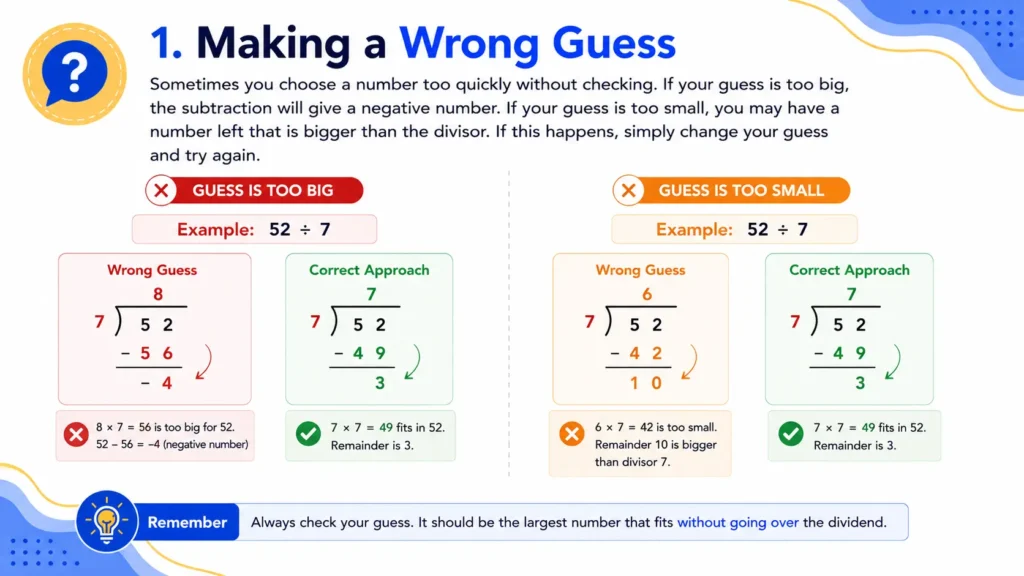
1. Making a Wrong Guess
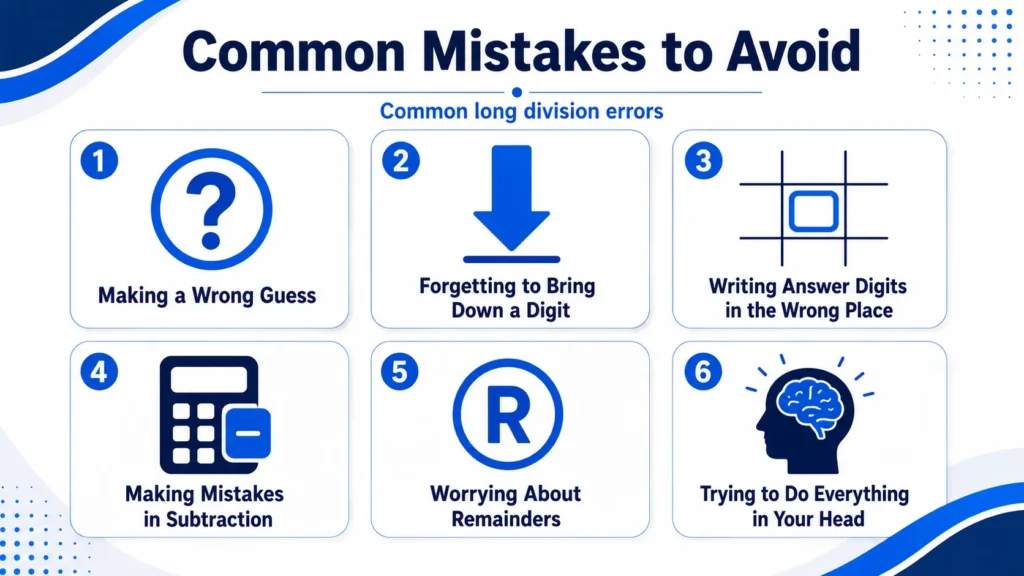
Sometimes you choose a number too quickly without checking. If your guess is too big, the subtraction will give a negative number. If your guess is too small, you may have a number left that is bigger than the divisor. If this happens, simply change your guess and try again.
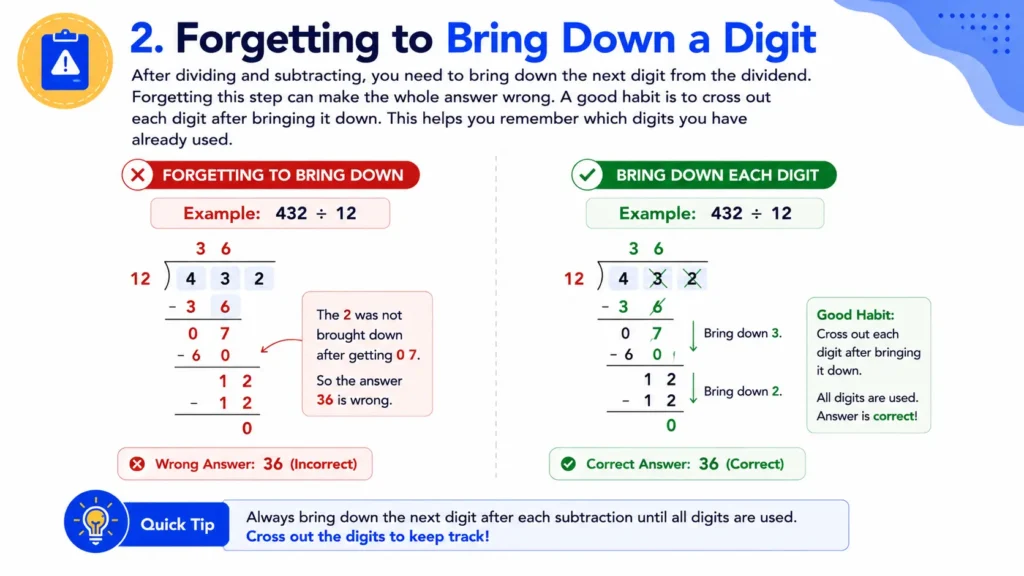
2. Forgetting to Bring Down a Digit
After dividing and subtracting, you need to bring down the next digit from the dividend. Forgetting this step can make the whole answer wrong. A good habit is to cross out each digit after bringing it down. This helps you remember which digits you have already used.
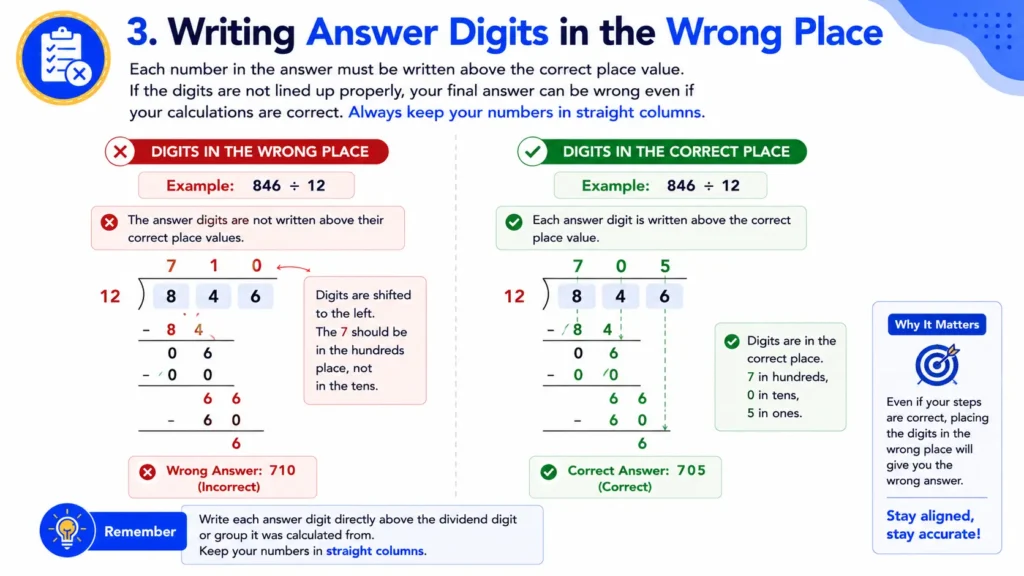
3. Writing Answer Digits in the Wrong Place
Each number in the answer must be written above the correct place value. If the digits are not lined up properly, your final answer can be wrong even if your calculations are correct. Always keep your numbers in straight columns.
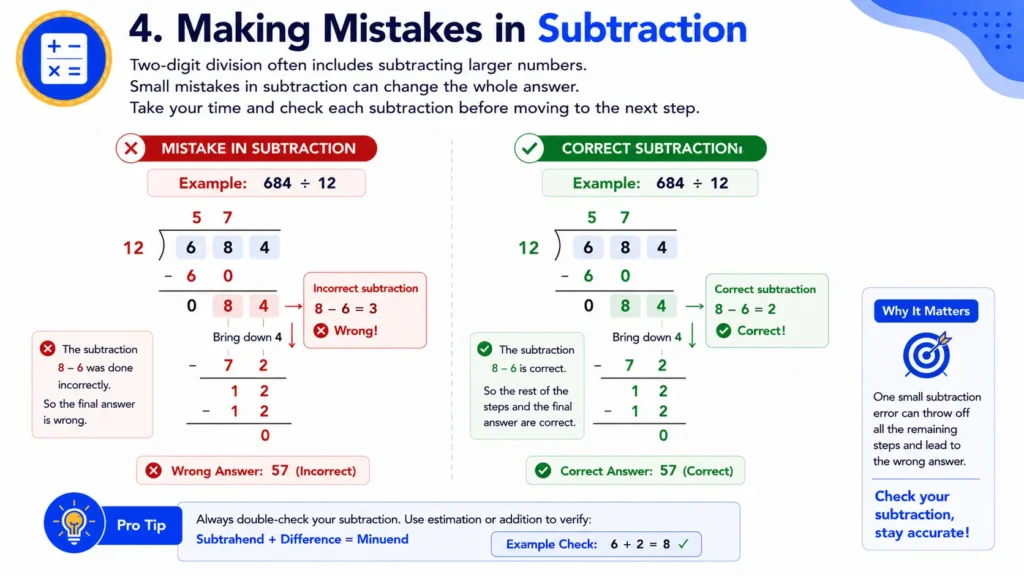
4. Making Mistakes in Subtraction
Two-digit division often includes subtracting larger numbers. Small mistakes in subtraction can change the whole answer. Take your time and check each subtraction before moving to the next step.
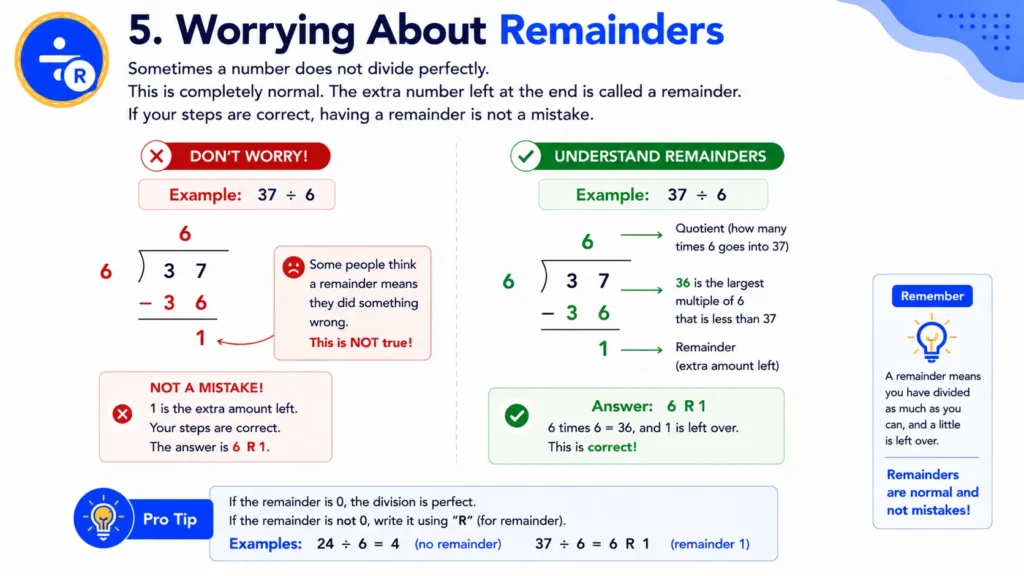
5. Worrying About Remainders
Sometimes a number does not divide perfectly. This is completely normal. The extra number left at the end is called a remainder. If your steps are correct, having a remainder is not a mistake.
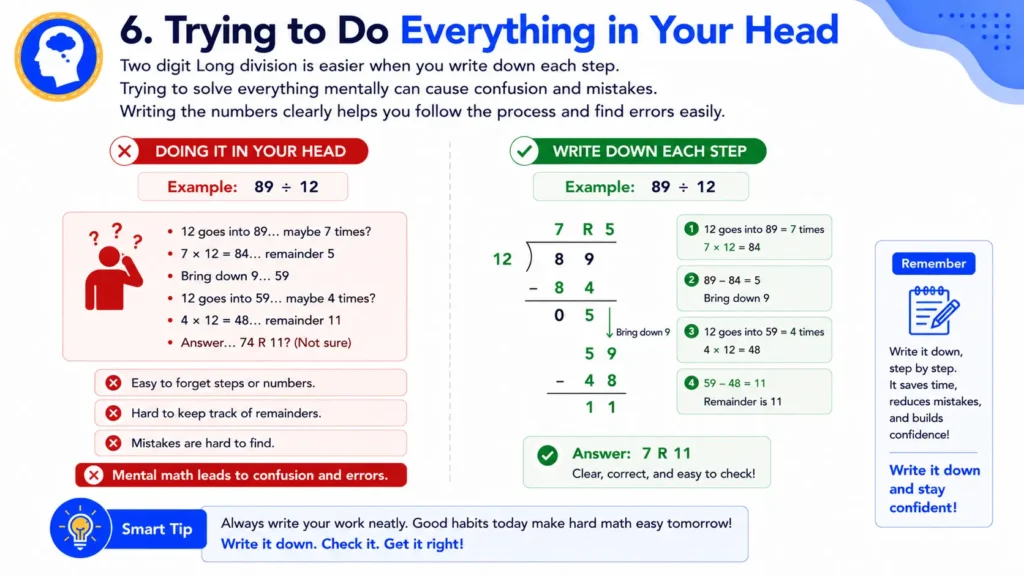
6. Trying to Do Everything in Your Head
Two digit Long division is easier when you write down each step. Trying to solve everything mentally can cause confusion and mistakes. Writing the numbers clearly helps you follow the process and find errors easily.
Conclusion
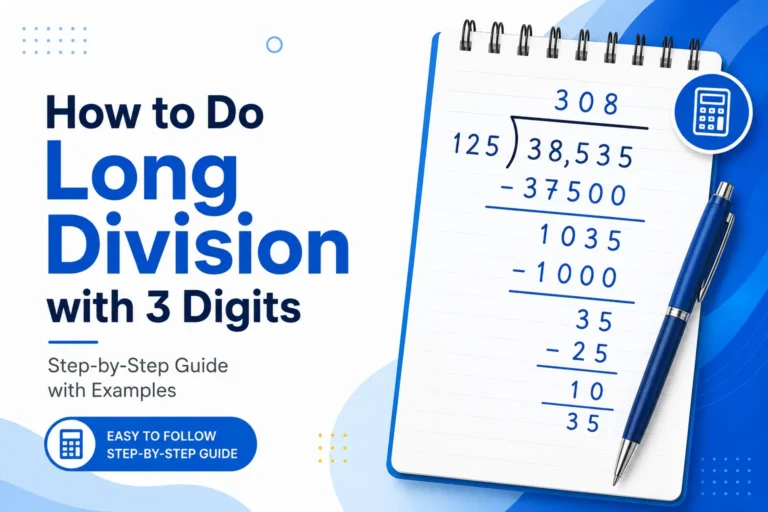
Two digit long division is really the same process you already know, just with a bit more estimating built in. Once you get comfortable rounding the divisor, testing your guesses, and following the divide, multiply, subtract, and bring down the pattern in order, the extra digit stops feeling like a big obstacle. Like most math skills, it gets faster and more natural the more problems you work through. Stick with the steps, check your work along the way, and two digit division will start to feel just as manageable as everything you learned before it. Once you understand two digit division, you can continue learning more complex examples such as long division with 3 digits.