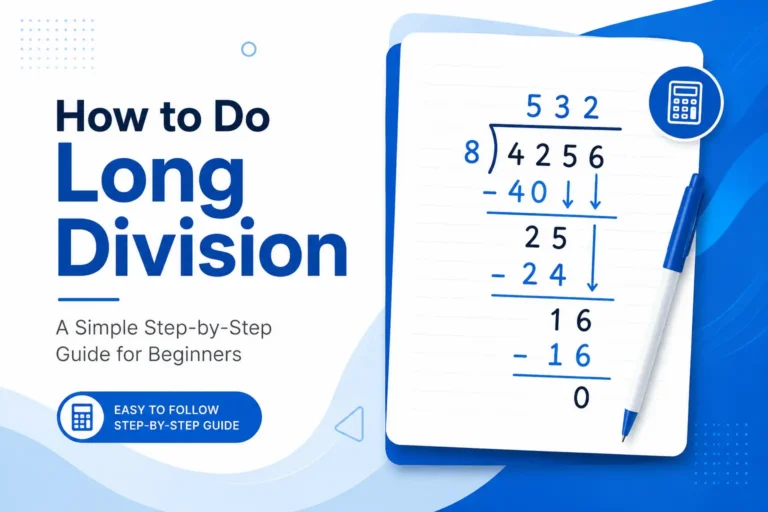
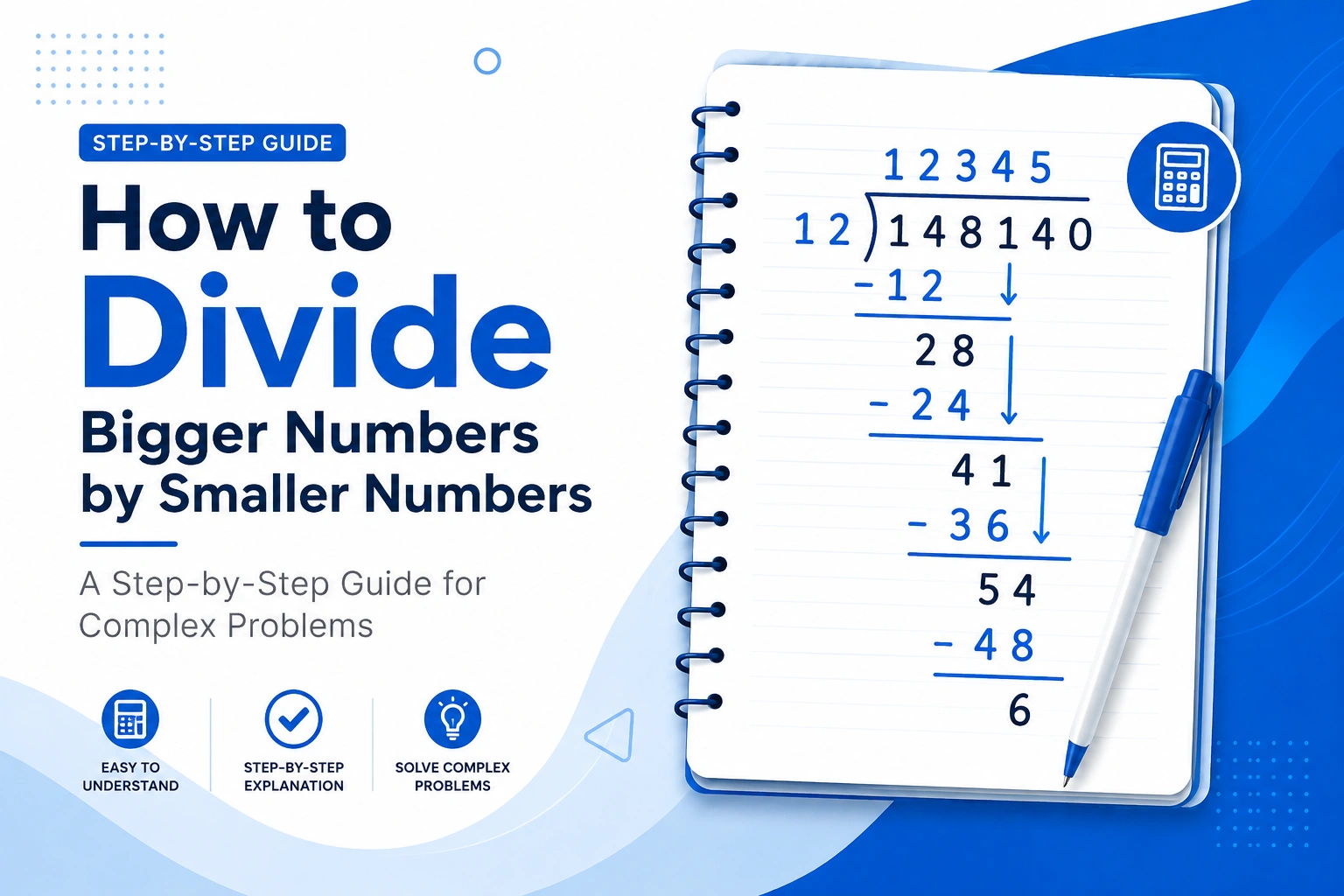
How to Divide Bigger Numbers by Smaller Numbers: A Step-by-Step Guide for Complex Problems
Introduction:
Dividing a small number is easy, but sometimes people make it really difficult because they don’t know how to handle the steps. Whether it is a big number or small number, the steps remain the same. This article will guide you how to handle the bigger numbers without getting lost.
How to Divide by Big Numbers
When you are dividing a small number by a big number like 15, 25, 48, or 125, the first and most important part is usually figuring out how many times the divisor fits into the dividend. Guessing can be confusing and slow, especially for beginners. A very simple and helpful method to solve this problem is called the Multiples List trick. It works like a small cheat sheet that you prepare before starting the division. You can also use our Long Division Calculator to verify your answers while learning.
How This Trick Works
Step: 01
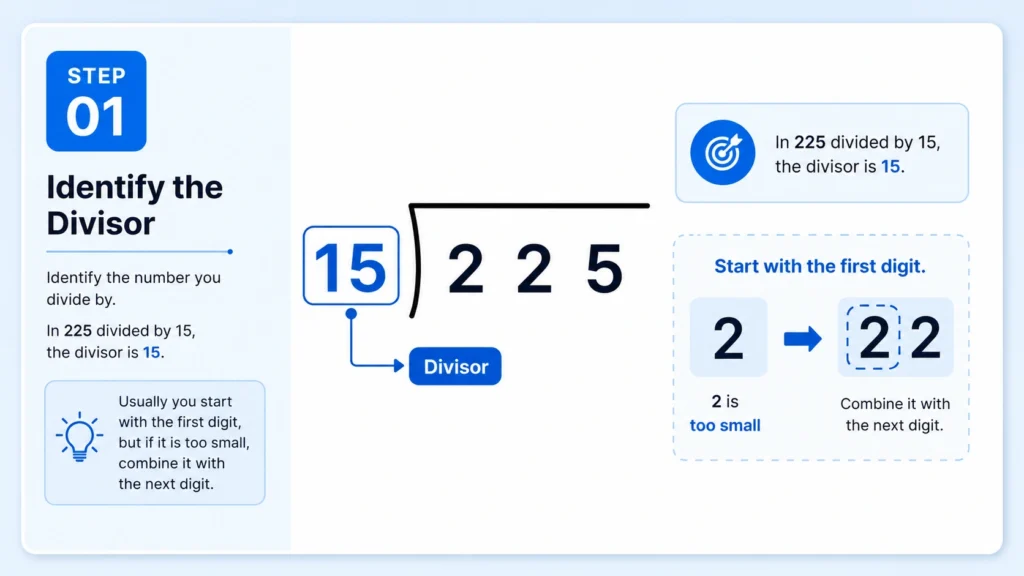
The first thing is to identify the number you have to divide. That number is called the divisor. Mainly the first digit is divided first but if it is small then you will add the second digit as well. For example, if you are solving 225 ÷ 15, then 15 is your divisor.
Step:02
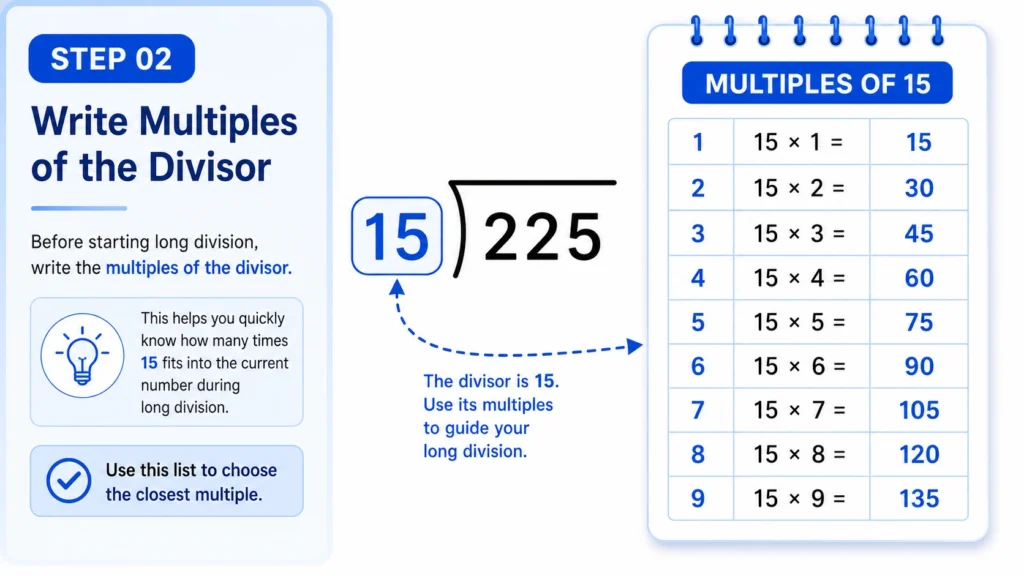
Before starting the long division, write down the multiples of your divisor (table of 15) from 1 to 9 on the side of your paper. For example, for 15:
- 15 × 1 = 15
- 15 × 2 = 30
- 15 × 3 = 45
- 15 × 4 = 60
- 15 × 5 = 75
- 15 × 6 = 90
- 15 × 7 = 105
- 15 × 8 = 120
- 15 × 9 = 135
This list will make it easy for you to know how much time 15 fits in the divisor. It will save your time, and also increase clarity in your problem.
Step:03
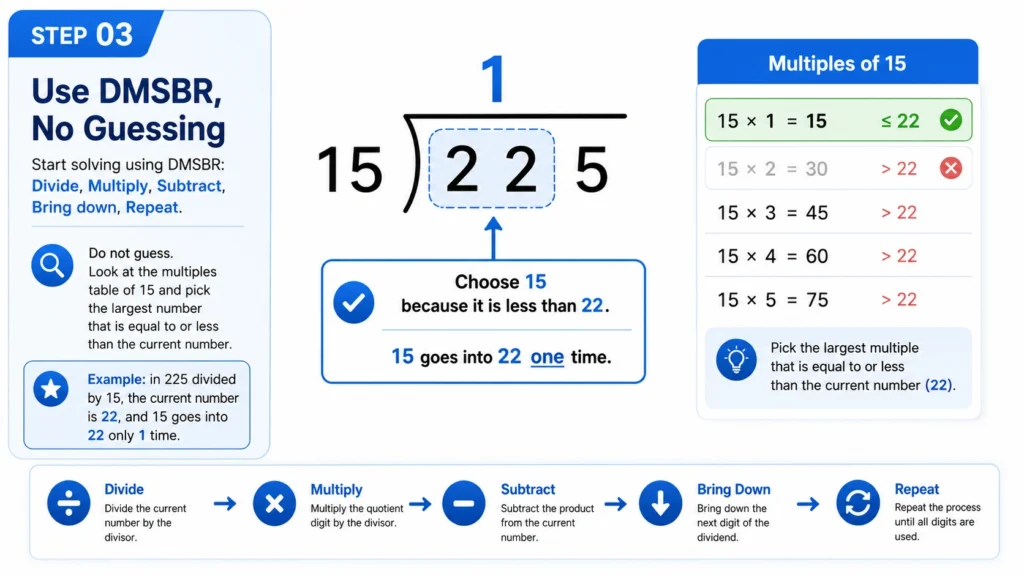
Now, when you start solving the division by using steps like Divide, Multiply, Subtract, Bring down (DMSBR), you don’t need to guess anymore. Just look at the list of table you made and pick the largest number that is equal to or less than your current number. For example; 15 goes only 1 time in 22.
Mastering Long Division with 4-Digit and 5-Digit Dividends
Long division looks difficult when you see large numbers like 4-digit or 5-digit dividends( 12,500, 5600), but once you understand the process, it becomes much easier. The key is to stay organized and follow the steps carefully.
Understand what to do:
When you work on bigger numbers (like 4,356 or 27,891), the most important but difficult thing is to keep track of digits. People often lose after repeating all the steps 1 or 2 times. The key is to break the problem into smaller parts, and it will make the problem feel very little to solve.
Step-by-Step Method (DMSBR)
D – Divide
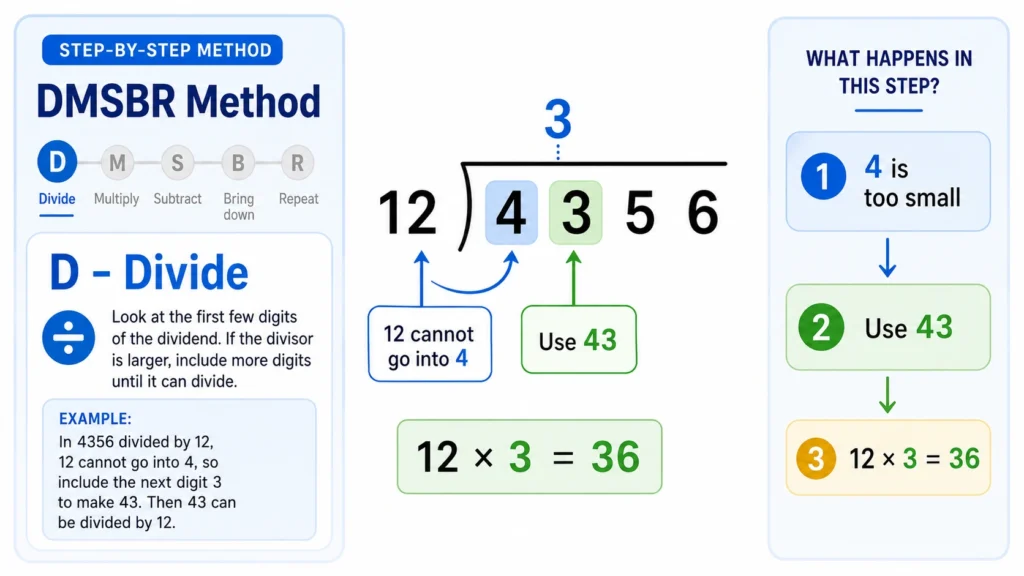
Look at the first few digits of the dividend. If the divisor is larger, include more digits until it can divide. For example: In 4356 ÷ 12, 12 can’t possibly come in 4, so we add 1 more digit in 4 that is 3, now 43 can be possibly divided by 12. 12 × 3 = 36
M – Multiply
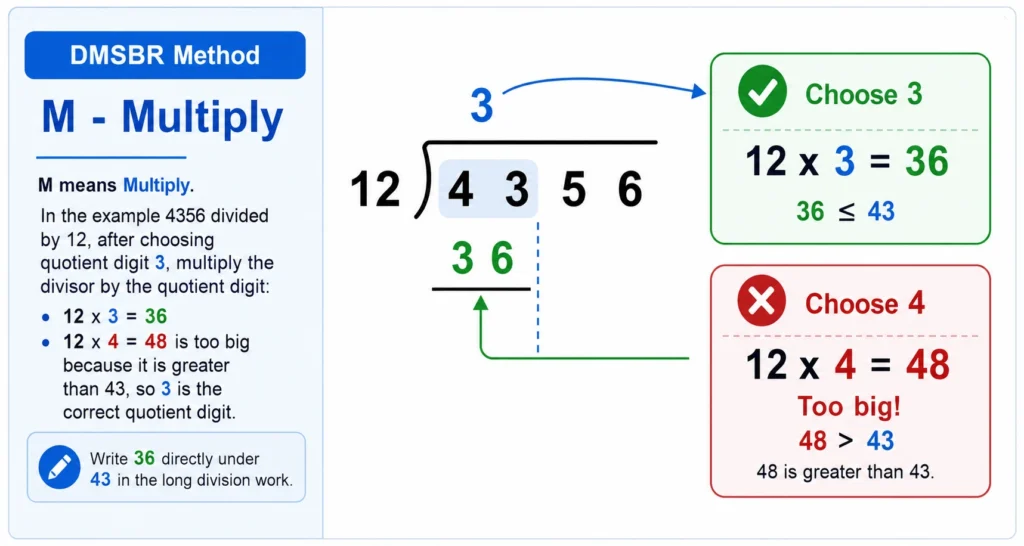
Now, multiply the divisor by the number you just wrote in the quotient that is 3. Since 12 × 3 = 36 and if we multiply 12×4=48, that is too big than 43, so we used 12×3. Write 3 right under 43.
S – Subtract
The next step is to subtract the result from the current number. For example; subtract 36 from 43 that is equal to 7.
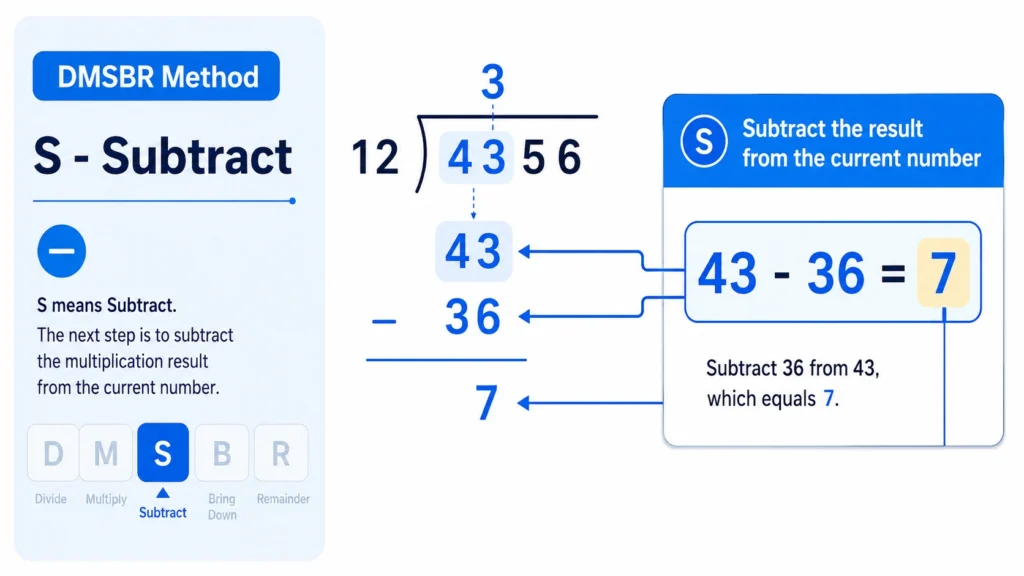
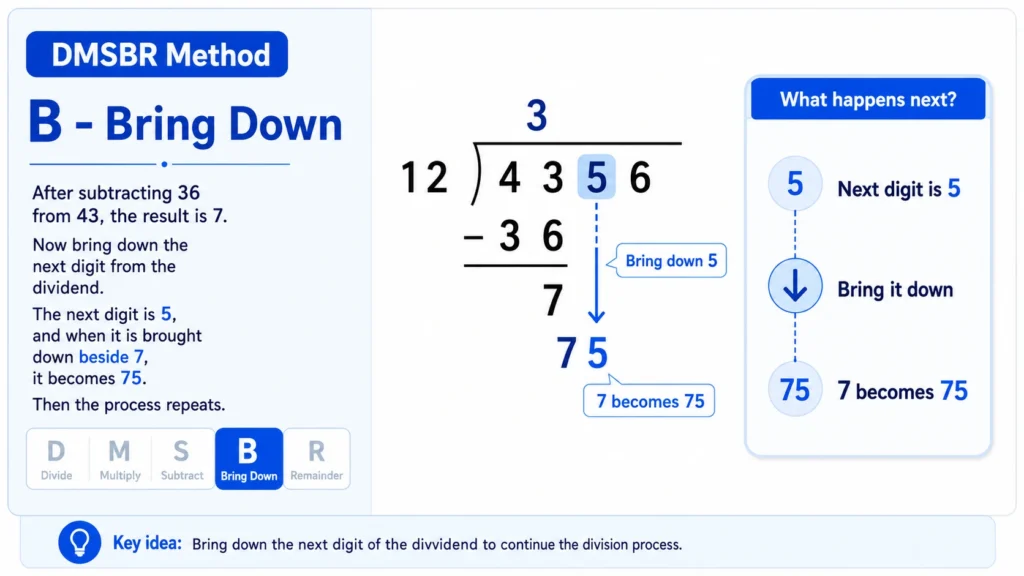
B – Bring Down
Now we will bring down the next digit from the dividend and repeat the process. The next digit is 5, when it is added with 7 it becomes 75.
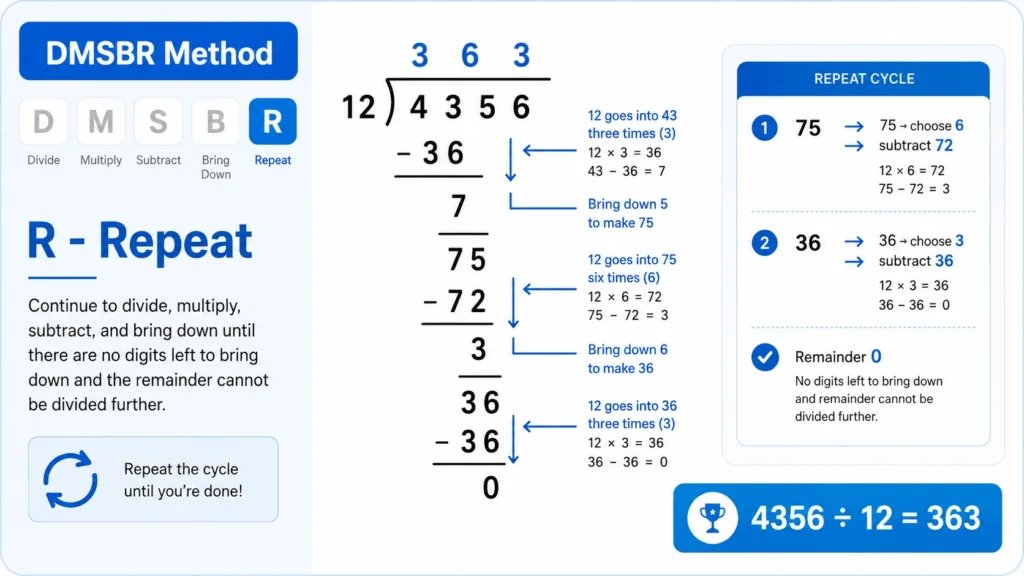
R – Repeat
Continue to divide and repeat the steps until there is no digit left in the remainder that can be divided by 12.
Long Division vs. Short Division: Which Method Should You Use
When solving division problems, you might hear long division and short division words mostly. Both the methods are the same and give the same answer, but there are some steps and rules that are different, and both the types are useful in different situations. If you know what is actually the difference between long division and short division, you will choose the best method for your problem.
Long Division Method vs Short Division Method
Both methods solve division problems, but they differ in speed, written steps, and the level of detail they provide.
Long Division Method
The long division method is a complete step-by-step process where every calculation is written clearly. It follows the DMSBR process: Division, Multiplication, Subtraction, Bring Down, and Repeat.
1. Divide 12 by 5 → 2 times
2. Multiply 5 × 2 = 10
3. Subtract 12 – 10 = 2
4. Bring down 0 → 20
5. Divide 20 by 5 → 4
Final Answer: 120 ÷ 5 = 24
Short Division Method
The short division method is quick and simple. Most calculations are completed mentally, and only the final answer or remainder is written.
5 goes into 12 two times.
5 goes into 20 four times.
Final Answer: 24
Tips to Make the Division Easier
Division, sometimes feels tricky because of large numbers, but we are sharing some tricks and tips to make the division easier for you. The first trick is very simple, you don’t have to add anything extra, just follow the step by step method. If the numbers are large, try breaking them into smaller parts and focus on one step at a time. You can also use multiple list tricks to quickly find the solution.
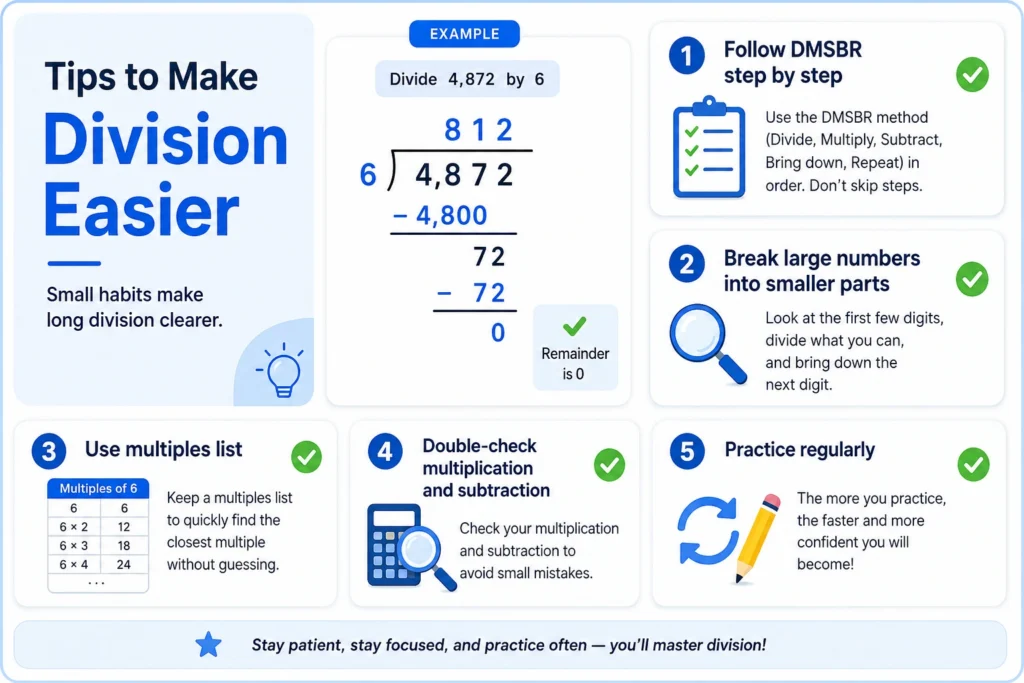
The other helpful trick is revision, always double check your all steps to know if something is wrong especially subtraction and multiplication because small mistakes change the whole answer. The more you practice, the more you become an expert in division.
Common Mistakes to Avoid
Many mistakes happen because of small errors, when you are aware of those errors, the chances of mistakes are reduced. A common mistake is starting with the wrong number. People often try to divide a number that is smaller than the divisor, which makes it confusing. Always choose a number that is equal to or bigger than the divisor before you start dividing.
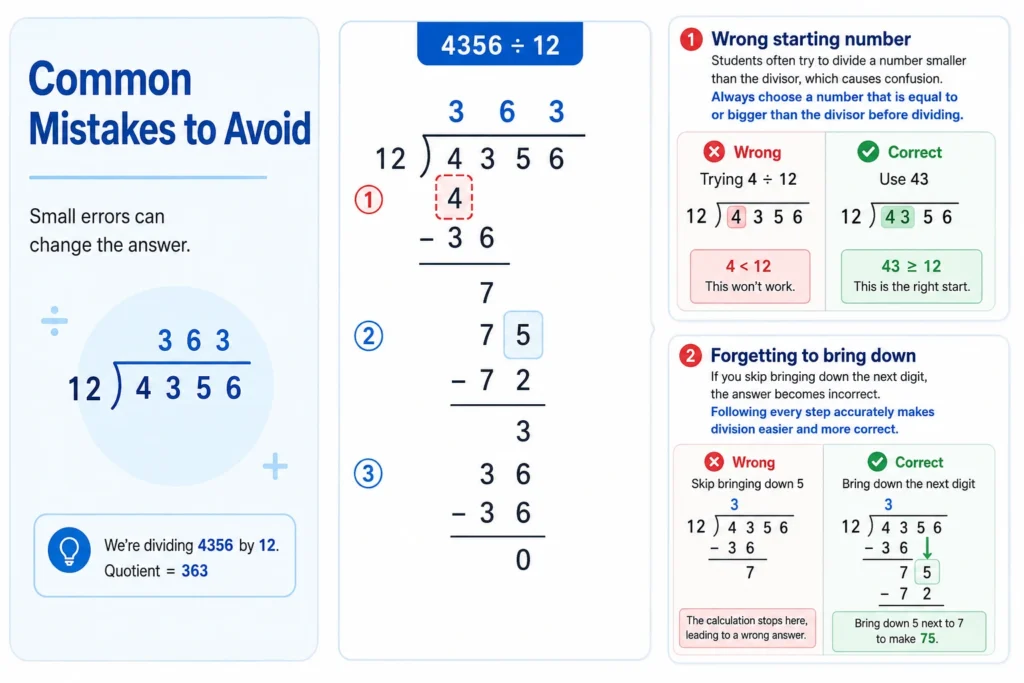
Another big mistake is forgetting to bring down the next digit. If you skip this step, you will not get the correct answer. Bringing down the next number after each step is also one of the important steps, you cannot proceed further if you forget this step. Following each step accurately makes the division easier and more correct.
Conclusion
Long division seems difficult but when you understand the steps and apply them as told, it becomes easier. By understanding the difference between short division and long division, you can choose the appropriate method for your calculation. Avoiding common mistakes and using helpful tips and tricks, gives you the confidence to solve the problem with clarity.
Frequently Asked Questions(FAQs)
Q1:What is the difference between long division and short division?
Long division is a step-by-step method where you write down every part of the process, like dividing, multiplying, subtracting, and bringing down numbers. It is best for solving problems with large numbers because it is easy to follow and check mistakes. Short division, on the other hand, is a quicker method where you do most steps in your head. It is best for small numbers but can be difficult to use with bigger numbers.
Q2: Is short division better than long division?
Short division is not always better than long division; it depends on the problem. It is faster and useful for small numbers, but it can be confusing for bigger numbers. Long division is better for large or complex problems because it shows all steps clearly.
Q3:What are common mistakes in long division?
People often forget when or how to bring down the next digit. They confuse which number to divide into at each step. They get lost in the sequence: divide, multiply, subtract, bring down. They complete the steps but don’t understand what the final answer means.